ANT CONTROL SERVICES
For organizations such as homes, residential buildings, hospitality buildings, office buildings, industrial facilities, hospitals, and food businesses, the presence of ants within operational areas is not simply a nuisance. It can indicate underlying issues related to sanitation, risk control, and overall facility management. Ant activity may affect corporate image, employee and visitor confidence, and compliance with operational standards that organizations are required to maintain.
Ant infestations can also impact hygiene, food safety, and building systems or equipment. If not properly managed, these issues may lead to compliance risks and long-term structural or operational problems. Effective ant control therefore requires a clear understanding of ant behaviour and life cycles, together with an assessment of how each area of the facility is used.
IFS provides consultation through experienced specialists to help organizations evaluate the most appropriate approach before service implementation.
ANT FACTS AND LIFE CYCLE
Ants are social insects found in nearly every region of the world and are highly adaptable to environments shared with humans, including agricultural areas, industrial zones, and residential or commercial buildings. Ants belong to the family “Formicidae” and live in colonies with complex nest structures and clearly defined roles.
Typical Ant Colony Structure
Ant colonies have clearly defined roles within the nest.
- Queen ant:
Responsible for reproduction and colony expansion. - Worker ants:
Responsible for searching for food, maintaining the nest, and establishing movement trails. - Male ants:
Responsible for mating.
Ant Life Cycle
Ant development occurs through four stages:
- Egg.
- Larva.
- Pupa.
- Adult.
A single colony can contain many ants. When nests are disturbed, ants may split into multiple colonies. This behaviour allows infestations to spread quickly across wider areas.
In buildings and industrial facilities, ant infestations create more than inconvenience. They can affect sanitation, food safety, and building equipment, potentially leading to operational risks and long-term maintenance costs. For this reason, effective ant control services require an understanding of ant behaviour and life cycles combined with careful analysis of building usage and environmental conditions.
COMMON ANT SPECIES FOUND IN BUILDINGS AND FACILITIES
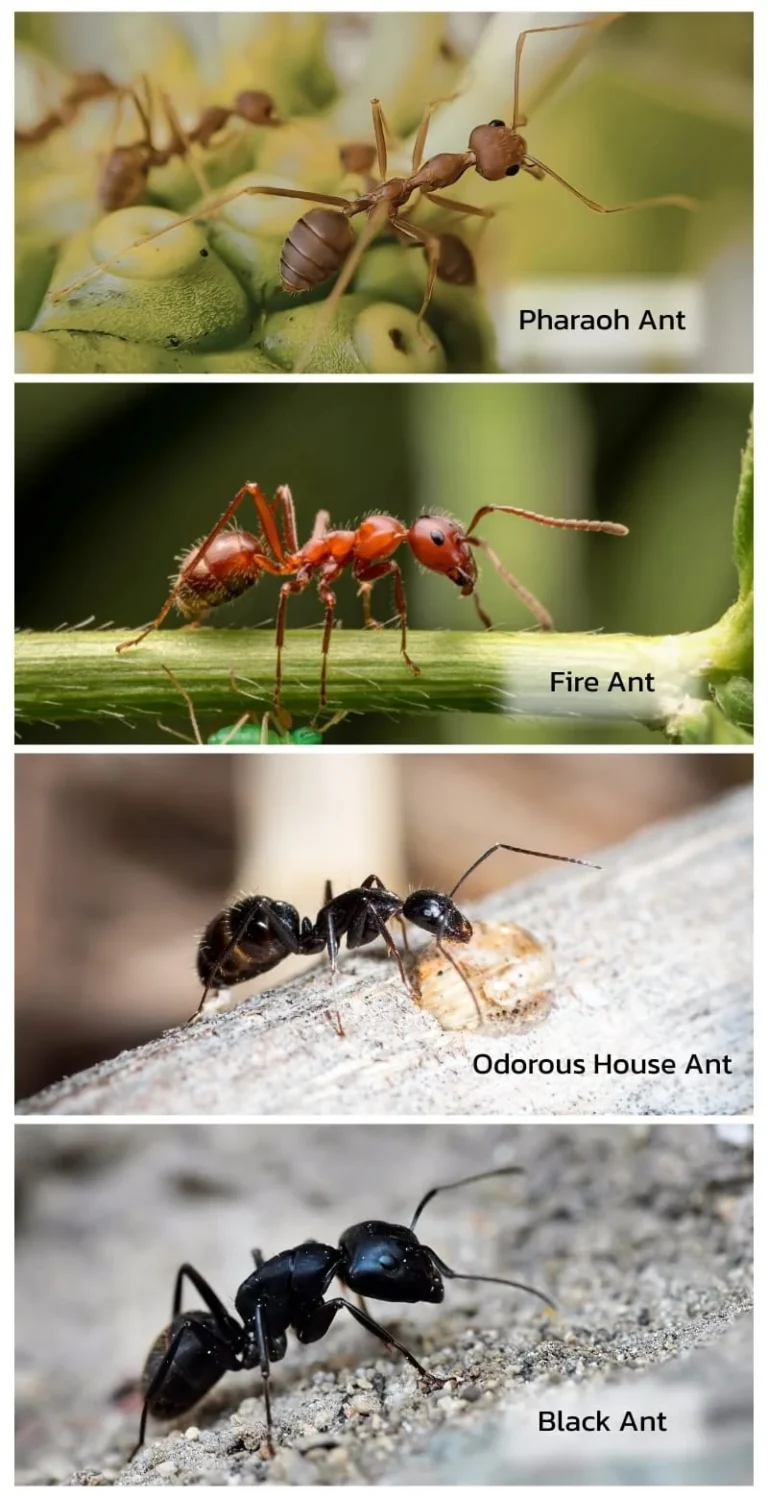
Identifying the ant species is essential for accurate control because each species has different behaviours, habitats, and impacts on buildings. Common species found in Thailand include:
Pharaoh Ant
Small ants with reddish-brown bodies and relatively translucent abdomens. They have twelve-segment antennae and a two-node waist. Pharaoh ants prefer sugars, fats, and proteins. They often nest in soil and are commonly found near residential areas or buildings. This species can easily enter buildings and become a persistent nuisance.
Fire Ant
Fire ants are typically yellowish-red with ten-segment antennae and a two-node waist. Their abdomen is oval-shaped with brown markings. They possess a stinger and can bite or sting, which may cause pain or allergic reactions. Fire ants usually live in soil outdoors but may move into operational areas.
Odorous House Ant
This species has a black head and thorax with a light-brown abdomen and long antennae. It has a single-node waist. When disturbed, it produces a distinctive odour. Odorous house ants may nest outdoors or inside building walls, which makes locating the nest more challenging.
Black Ant
Black ants are dark brown or black with twelve-segment antennae, a single-node waist, and relatively long legs. They prefer sweet food sources and are often found in gardens or green areas. When they appear near buildings, it may indicate that a colony is located nearby.
Accurate species identification helps determine the most appropriate control method, whether through targeted treatment or bait systems, and reduces the risk of recurring infestations.
ANT BEHAVIOR IN BUILDINGS AND FACILITIES
Ants typically follow established trails when searching for food. They use pheromone signals to guide movement between the nest and food sources. Foods preferred by ants include sugars, fats, and proteins, which are commonly present in organizational environments such as cafeterias, kitchens, staff break rooms, meeting areas, or storage rooms.
From a structural perspective, ants may nest in soil, beneath floors, within wall voids, inside cracks, or near plumbing systems. Buildings with moisture accumulation or areas that are difficult to clean may create favourable conditions for ant activity.
Ant infestations are rarely caused by cleanliness alone. Several factors often contribute, including accessible food sources, moisture from plumbing systems or ventilation, and structural cracks that provide entry points and nesting areas. In addition, inappropriate treatment methods may cause colonies to split and spread further, making the problem more difficult to control.
For these reasons, ant control in organizational environments requires specialists who understand both insect behaviour and building systems.
SYSTEMATIC ANT CONTROL APPROACH
IFS provides ant control services through a structured process designed for organizational environments. Service planning considers building characteristics, ant species, and risk levels specific to each facility.
The process begins with a detailed site inspection to identify nesting sources, risk areas, and environmental conditions that support infestation. Based on this assessment, IFS develops a suitable management plan for the site.
Control methods may include targeted chemical treatment at cracks and risk areas or the use of bait and gel systems. Worker ants carry these substances back to the nest, helping control the queen and the colony.
Services cover both indoor and surrounding outdoor areas. Continuous monitoring, situation assessment, and service reporting are included. In addition, recommendations on sanitation and preventive practices are provided to facility managers.
This structured approach helps organizations manage ant problems effectively and reduce long-term risks rather than addressing the issue only after it appears.
IFS ANT CONTROL SERVICE PROCESS
Site inspection and
assessment

Analysis and
service planning

Implementation
of the control plan.


Inspection and
service reporting

Long-term prevention
planning
Site inspection and
assessment
Analysis and
service planning
Implementation
of the control plan
Inspection and
service reporting
Long-term
prevention planning
FREQUENTLY ASKED QUESTIONS ABOUT ANT CONTROL SERVICES
What types of organizations are ant control services suitable for?
They are suitable for residential buildings, office buildings, industrial facilities, hospitals, hotels, distribution centres, and food businesses that must maintain sanitation standards and corporate image.
How does IFS assess ant infestations differently from other providers?
IFS prioritizes detailed on-site inspections to identify ant species, nesting locations, and facility risk factors before selecting control methods. We do not apply the same treatment approach to every site.
If previous pest control services were ineffective, can IFS resolve the problem?
Yes. Our specialists evaluate the reasons previous treatments were unsuccessful, such as unsuitable methods, overlooked nesting areas, or changes in ant behaviour. A new control plan is then developed based on the actual site conditions.
Should spray treatment or gel bait be used for ant control?
The appropriate method depends on the ant species, facility environment, and operational requirements. IFS selects the most suitable method with minimal impact on operations.
Will the service disrupt business operations?
Service schedules can be arranged outside working hours or applied in specific areas to minimize impact on staff and operations.
How many service visits are required to see results?
Results typically begin to appear within one or two service cycles, depending on infestation levels and environmental conditions.
Is service monitoring and reporting provided?
Yes. IFS prepares service reports and records after each visit.
How are service costs determined?
Pricing depends on factors such as facility size, infestation level, ant species, building complexity, and service frequency. IFS conducts a site assessment before providing a proposal.
Can service contracts be customized?
Yes. Contract formats can be adjusted based on business type, risk levels, and budget.
Why do organizations choose IFS for ant control services?
IFS understands facility management and organizational risk control. Our services focus on systematic management aligned with corporate standards and aim to reduce the likelihood of recurring infestations over the long term.
Request for a Free Consultation and Site Assessment by Our Experts
IFS provides professional pest prevention and control services and will recommend a control plan suited to your facility and risk profile.
IFS provides professional pest prevention and control services and will recommend a control plan suited to your facility and risk profile.