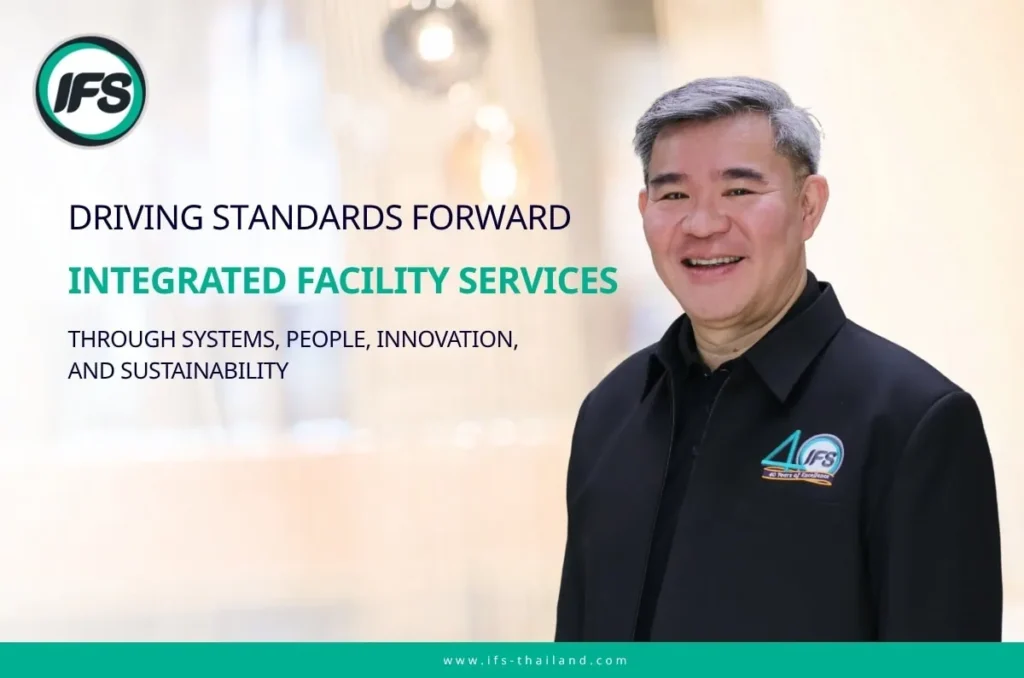
Mr. Sapphaphet Pojasan, Chief Executive Officer (CEO) of the IFS Group, shared the organization’s recent development direction, emphasizing that elevating integrated facility services is not simply about expanding scale, but about strengthening management structures to ensure clarity and transparency.
Operating nationwide and working with both public and private sector organizations, the IFS Group focuses on building systems that support organizations of all sizes, while maintaining long-term consistency in service quality.
This interview reflects the executive perspective on growth strategy and highlights the role of the IFS Group as a strategic partner to leading organizations at the national level.
How does the IFS Group define “Integrated Facility Service Standards” from the perspective of a national-level organization?
Mr. Sapphaphet:
From our perspective, “integrated” does not mean simply combining multiple services. It means designing a facility management system in which all processes operate in coordination under a unified standard, from policy level to on-site execution.
The IFS Group offers comprehensive solutions across multiple areas, with three core services forming the foundation of our clients’ organizational structure: cleaning services, security services, and manpower outsourcing.
We place strong importance on managing our workforce in alignment with our clients’ business objectives. In reality, facilities managed through a structured system clearly support operational efficiency, safety, and business continuity. We do not view our role as merely a support function. We are part of the core operational structure.
Ultimately, what defines “standards” is the presence of clear KPIs, transparency, auditability, and the ability to continuously adapt to changes in organizations and the business environment.
What are the key factors that enable the IFS Group to continuously drive service standards?
Mr. Sapphaphet:
If I may answer directly, the most important factor is people.
Our business is driven by more than 30,000 employees nationwide. The real challenge is not the number of people, but ensuring that everyone operates under the same standard, regardless of location or function.
We address this by establishing a clear quality management system and continuously investing in people development, including professional skills, safety standards, and leadership at all levels. I believe that sustainable organizational growth requires people to grow alongside it.
At the same time, another critical factor is organizational culture.
We are committed to building a culture based on transparency, accountability, and trust. These are not just statements, but principles that must be reflected in actual day-to-day operations.
When employees feel that the organization operates with clear principles, they are more willing to dedicate themselves to their work and grow with the organization over the long term.
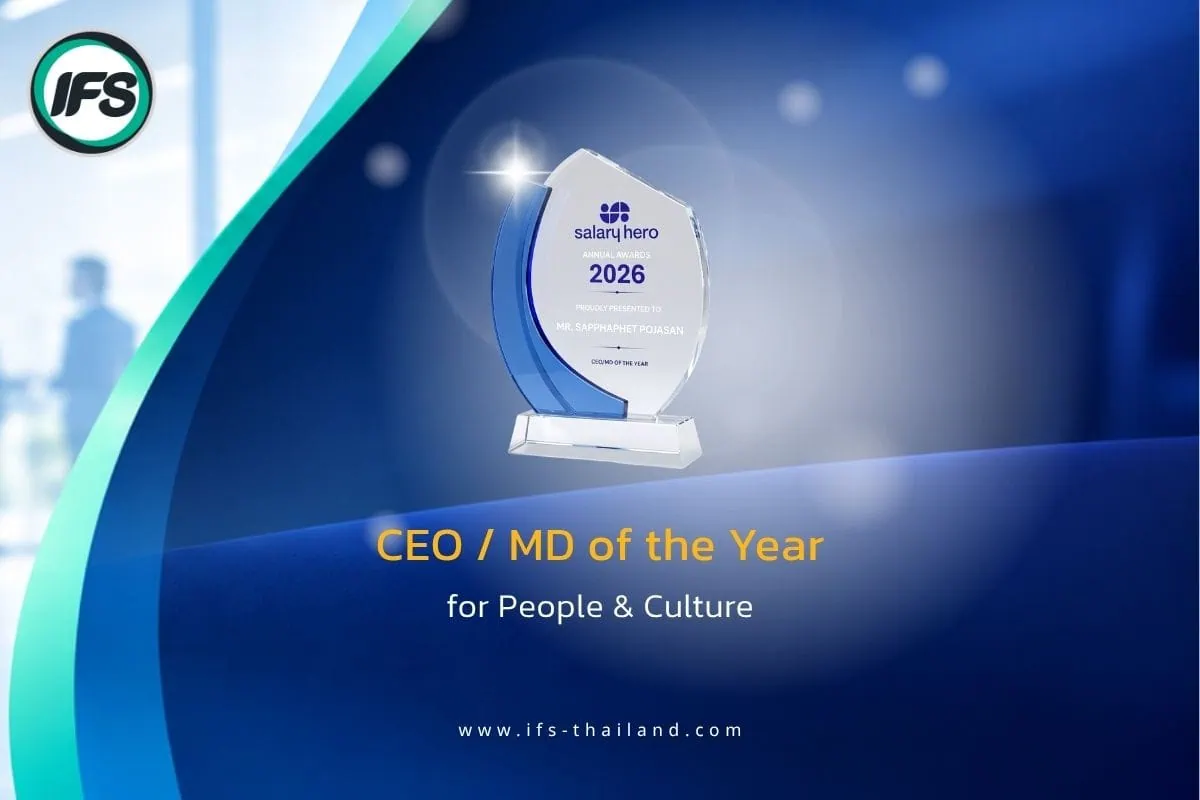
These efforts are reflected in tangible outcomes, such as receiving the THAIHRM Best Workplace Award 2026 at the Gold level and Workplace Excellence Certification, which affirms our standards in people management, organizational culture, and work environment at the national level.
Another important element is the use of technology to support operations and control quality. Technology does not replace people but enhances their performance.
When systems, people, organizational culture, and technology move in the same direction, sustainable service standards are not coincidental, but the result of deliberate and continuous effort.
With over 41 years of experience originating from ISS Thailand, what key lessons and strengths have been carried forward to the IFS Group?
Mr. Sapphaphet:
To explain our origins, we must go back to when we operated under ISS Thailand, a brand originating from Denmark, which introduced global facility management standards to Thailand.
Over more than 40 years , we have accumulated experience, developed operational approaches, and established structured management systems. These have become the foundation of the IFS Group today.
One key lesson from over four decades is that enterprise-level services cannot rely solely on individual capability. They require clear, auditable systems that can replicate the same standards consistently across all locations. This has always been our core strength.
By building on this foundation and adapting it to each client’s context, we are able to support large organizations and complex projects with stability, while meeting strict governance requirements. I believe this is a key reason why we continue to earn trust and maintain our position at the national level.
How would you describe the scale, capability, and strength of the IFS Group within Thailand’s facility services industry?
Mr. Sapphaphet:
Currently, the IFS Group generates over THB 7 billion in annual revenue, employs more than 30,000 personnel, and manages over 2,000 projects nationwide across both public and private sectors. These figures reflect the trust our clients place in us.
Our group structure is designed so that each entity specializes in its respective area. However, all operate under the same standards and direction. I believe clients do not evaluate just one company, but the overall capability of the entire group, including its stability, transparency, and ability to operate at a national scale.
From a management perspective, how does the group structure support quality control, standards, and risk management?
Mr. Sapphaphet:
From a management perspective, the structure of the IFS Group is not only designed to separate expertise across services but also plays a critical role in ensuring systematic quality control and risk management.
We have centralized governance that oversees the entire group, including audit systems, KPIs, and standardized processes applied across all entities. I believe that strong standards must not depend on any single company but must be built on a unified system across the entire organization.
Amid increasing competition, what growth strategy has the IFS Group adopted?
Mr. Sapphaphet:
In a highly competitive environment, we do not focus solely on increasing the number of contracts or expanding service areas. We focus on improving internal efficiency alongside growth.
In 2025, we achieved 15 percent profit growth, reflecting strong management performance and organizational strength. We have set a target of 20 percent profit growth for 2026. These results are driven by stricter cost control and clearly defined operational direction.
Another important approach is the concept of Account Manager as Micro-Business Owner. This means that each unit leader manages their operations as if it were their own business, taking responsibility for revenue, costs, quality, and outcomes.
I believe this approach increases organizational agility, enables faster decision-making, and helps maintain consistent service standards over the long term.
How does the IFS Group approach sustainability and ESG at a national level?
Mr. Sapphaphet:
For me, sustainability is not about image, but a clearly defined business framework.
Under the IFS Group’s ESG policy, we ensure that organizational growth goes hand in hand with tangible environmental and social responsibility.
From an environmental perspective, we take a systematic approach, from policy to actual operations, including efficient resource usage, greenhouse gas reduction, and responsible procurement that considers environmental and social impact.
In practice, we use environmentally friendly cleaning products and emphasize employee awareness, such as proper waste segregation and compliant waste management.
At the same time, we integrate low carbon sustainability into our operational processes to ensure measurable impact.
From a governance perspective, we operate under clear, transparent, and auditable frameworks to ensure accountability and continuous monitoring.
The key is to embed ESG into our management systems, not just present it in reports. As a national-level organization, we also play a role in enabling our clients to achieve their sustainability goals in a tangible and measurable way, based on transparency, accountability, and long-term development.
How does the IFS Group view its role as a partner to client organizations?
Mr. Sapphaphet:
We do not see ourselves as merely a service provider within the scope of a contract. We are a long-term partner.
We support clients in areas ranging from risk management and cost control to operational efficiency and business continuity. Facility services today directly impact on the overall performance of client organizations.
We focus on delivering clear standards and auditable systems so that clients can be confident we are moving in the same direction and creating long-term value together. That is what partnership means from my perspective.
.
Conclusion
Amid changes in the facility services industry, sustainable growth is not defined by speed, but by clarity of systems and accountability in every decision.
For the IFS Group, success is not measured by size alone, but by the ability to deliver consistent standards, build trust, and grow sustainably alongside clients.Ultimately, credibility is the most difficult asset to build, and it is what we are committed to maintaining at every level of the organization.