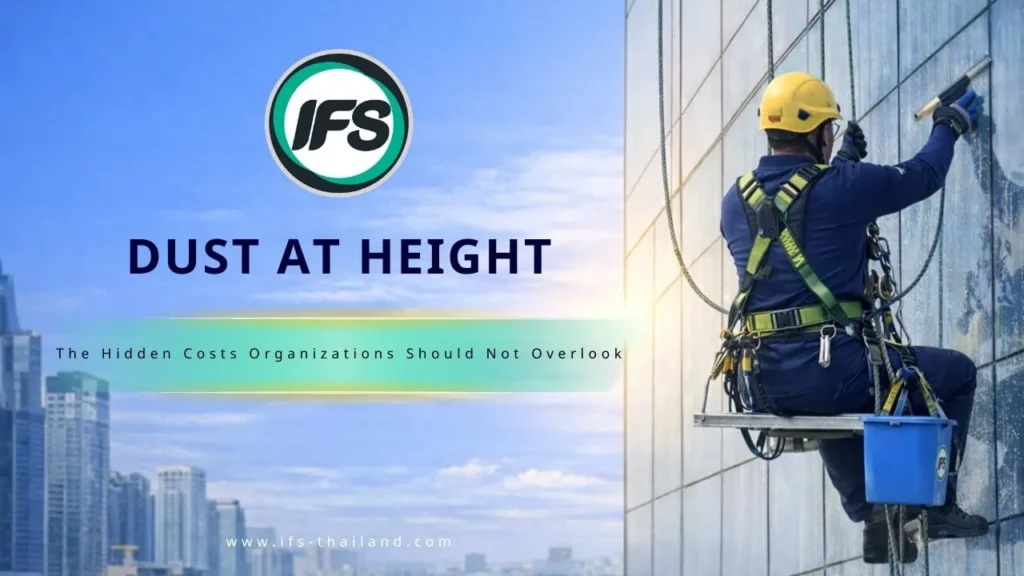
Cleaning high-rise buildings is not solely about exterior appearance. It is a long-term cost control strategy. Glass facades and exterior structures above eye level accumulate dust, pollution, moisture, and airborne chemicals every day. The impact may not be visible in the first month. However, after one to two years, deterioration becomes clearer and is often reflected in higher-than-expected maintenance expenses.
Many organizations evaluate high-rise cleaning primarily based on cost per service. While this approach is reasonable, a more strategic question is this; Without a structured high-rise cleaning plan, how much will the building maintenance costs increase over the next three to five years?
What is not visible today may become a significant budget item in the future.
Real Issues That Affect High-Rise Buildings
Consider a 30 to 40-story office building located along a major road. Thousands of vehicles pass daily, releasing soot and fine particulate matter that continuously settles on the glass facade. When it rains, water carries these particles across the surface, leaving behind a thin film that dries and adheres to the glass.
At first, the residue may not interfere with building operations. Over time, however, the glass becomes dull, clarity decreases, and stains become increasingly difficult to remove. Without routine high-rise cleaning at appropriate intervals, contaminants can bond firmly to the surface and require more intensive cleaning methods. These methods may increase the risk of damaging protective glass coatings.
Aluminium frames and sealing joints are also frequently overlooked. When contaminants accumulate over extended periods, seals may deteriorate faster than expected and eventually lead to water leakage inside the building.
This is where hidden costs begin to develop gradually, often before an organization becomes aware of them.
Dust and Pollution Cause More Damage Than Expected
Residue on high-rise buildings is not merely cosmetic. It results from ongoing chemical reactions.
Fine particulate matter and soot often contain heavy metals. When combined with moisture, they accelerate oxidation and cause metal frames to corrode or degrade more rapidly.
Acidic rainwater with low pH levels can erode glass coatings, paint layers, and metal surfaces.
Mineral deposits from rainwater leave white stains. When repeatedly accumulated, they create surface roughness and may cause permanent damage.
Regular facade and glass maintenance therefore does more than restore clarity. It protects surface integrity and helps delay premature material deterioration.
A well-planned high-rise cleaning program slows material degradation and reduces overall long-term maintenance costs.
Hidden Costs That Affect Organizational Performance
The cost impact extends beyond cleaning fees. It includes premature replacement of glass or exterior materials, emergency repair expenses, installation labour, temporary area closures, and related business disruption. These costs do not occur at all at once. They accumulate gradually, like compound interest.
Without a structured high-rise maintenance plan, future budgets may increase unnecessarily.
Asset Depreciation
Exterior building materials are designed to meet specific service life standards. However, without regular cleaning and preventive care, their lifespan may decrease by 10 to 20 percent.
For example, if a glass panel is designed to last 15 years but requires replacement in year 12, the three-year gap represents additional cost. This includes the cost of materials, installation labour, and operational management.
Allowing residue to accumulate results in repair or replacement earlier than planned.
Escalating Costs When Problems Are Delayed
When deterioration progresses to the point of urgent repair, costs are typically higher than preventive maintenance. Specialized teams, equipment, and after-hours operations may be required.
In some cases, parts of the building must be temporarily closed, affecting tenants and revenue.
A structured high-rise cleaning plan reduces budget volatility and enables more predictable control of long-term maintenance expenses.
Impact on Corporate Image
A building reflects an organization’s management standards. Dull or visibly stained glass reduces first impressions immediately.
Organizations that consistently maintain their building facades preserve a professional appearance and reinforce confidence among partners, clients, and employees.
A building’s image reflects the organization behind it.
Safety Risks
Long-term residue accumulation affects more than appearance. It directly impacts surface integrity and structural strength.
Continuous exposure to dust, moisture, and pollutants can accelerate metal corrosion, degrade protective coatings, and weaken anchoring points on the building façade. These changes develop gradually and may not be visible until significant damage occurs.
High-rise cleaning operations rely on anchor points and structural components to support rope access systems or suspended platforms. If corrosion accelerates deterioration, work may proceed under compromised structural conditions without immediate awareness. Risk does not arise solely from work procedures. It may also result from the building’s reduced structural readiness.
When surface strength and anchor integrity decline, the likelihood of incidents at height increases. The consequences may extend beyond repair costs to include injury, property damage, reputational harm, and legal liability.
Regular high-rise cleaning therefore serves not only aesthetic purposes. It also supports ongoing inspection and preservation of exterior structural components, forming a critical foundation for safe building operations.
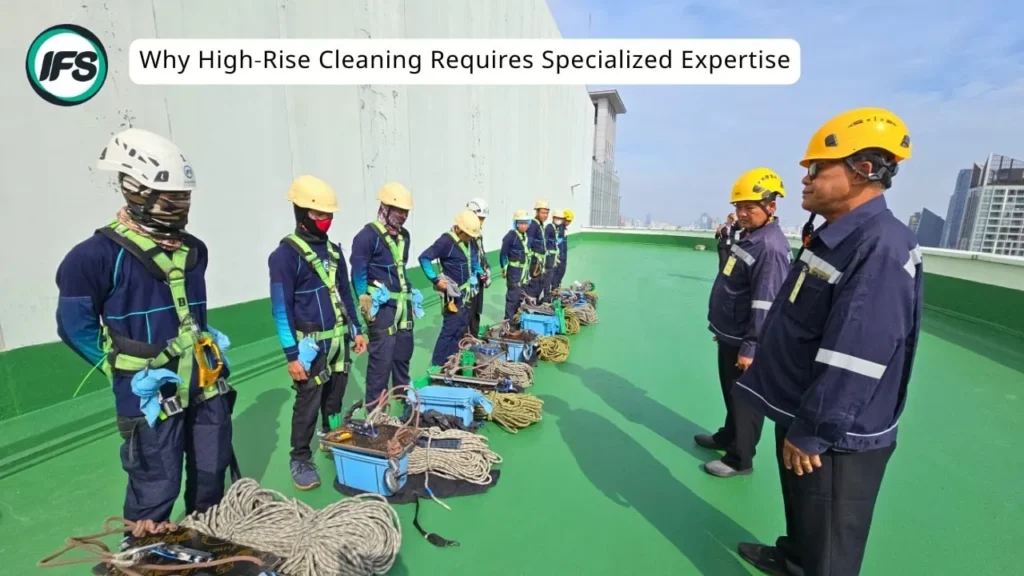
Why High-Rise Cleaning Requires Specialized Expertise
High-rise cleaning does not refer only to extremely tall buildings. It includes any task performed above normal ground level using ladders, scaffolding, boom lifts, or rope access systems. Even work conducted at relatively modest heights carries fall risks and requires professional safety standards.
When selecting a high-rise cleaning provider, organizations should consider not only building height but also the nature of the work, environmental conditions, and access methods.
Key evaluation criteria include:
- Internationally recognized safety training such as IRATA certification or equivalent working at height qualifications.
- Risk assessment conducted before every project.
- Inspection of anchor points, fall protection systems, and equipment prior to operations.
- Public Liability Insurance and worker accident coverage.
- Post-service reporting and quality control systems.
Professional high-rise specialists assess height, surface conditions, wind direction, structural limitations, and equipment suitability before beginning work. Safety depends on comprehensive risk management for each specific task.
Strong standards protect not only workers but also organizational budgets.
High-Rise Cleaning Services by IFS
IFS provides comprehensive high-rise cleaning services covering exterior glass, facades, structural elements, and hard to access areas. Service methods are tailored to each building type, including office towers, shopping centres, industrial facilities, and architecturally complex structures.
Before commencing any project, IFS conducts detailed site assessments that evaluate building height, structural configuration, anchor points, environmental conditions, and risk levels. This ensures that the safest and most efficient access method is selected.
IFS teams are trained in working at height safety standards and operate under structured risk control procedures. Equipment is inspected before each use, and all work is performed in strict compliance with applicable safety regulations.
IFS high-rise cleaning focuses not only on surface cleanliness. The team also observes visible structural irregularities, documents site conditions, and provides preventive recommendations to support systematic long-term maintenance planning.
IFS do more than clean glass. The company serves as a high-rise specialist that helps organizations manage risk, preserve asset value, and control long-term building maintenance costs professionally.
Frequently Asked Questions
Q: How often should a high-rise building be cleaned?
Frequency depends on location and environmental exposure. Buildings near major roads or in high pollution areas should typically be cleaned two to four times per year. Buildings in lower pollution areas may follow an annual schedule based on site evaluation.
Q: What happens if cleaning is postponed?
Delaying scheduled cleaning allows contaminants to accumulate deeply on surfaces. This may require more intensive cleaning methods, increase the risk of coating damage, shorten material lifespan, and raise maintenance costs over the next three to five years.
Q: Does high-rise cleaning involve safety risks?
Yes, if proper standards are not applied. Providers should conduct risk assessments, inspect anchor points, follow recognized safety certifications such as IRATA, and maintain appropriate Public Liability Insurance.
Q: What factors determine pricing?
Costs depend on building height, structural design, accessibility, level of residue accumulation, access method such as rope access or suspended platform, and required safety measures. A site assessment is essential before providing an accurate quotation.
Q: Does high-rise cleaning reduce long-term costs?
Preventive maintenance slows deterioration of glass, metal frames, and seals, reduces emergency repair risks, and extends material lifespan. It enables more effective long-term budget control compared to reactive repairs.
Q: How should organizations select a provider?
Evaluate safety standards, experience in working at height, risk assessment systems, equipment inspection procedures, reporting capability, and support for maintenance planning. Price per service should not be the sole consideration.
Conclusion: Preventive Care Is the Key to Controlling Building Costs
Dust accumulation at elevated areas may seem minor today. Over time, it accelerates structural deterioration and weakens exterior components, leading to hidden costs. These include premature material replacement, urgent repair expenses, safety risks, and reputational impact.
A structured high-rise cleaning plan is not routine maintenance. It is a strategic mechanism for long-term cost control, budget stability, and structural readiness.
Organizations that implement preventive high-rise maintenance systems preserve asset value, manage risk effectively, and build stakeholder confidence sustainably. Systematic care of elevated areas protects the building, the budget, and the organization’s reputation at the same time.
For more information about IFS high-rise cleaning services, please visit our service page to explore professional building care solutions.
Click Here