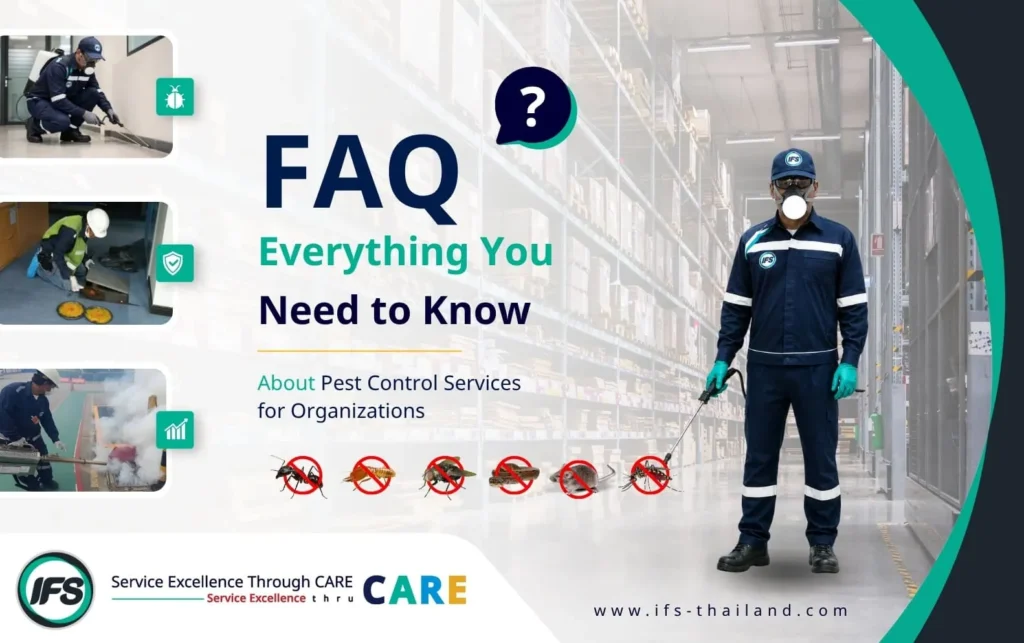
Pest control services for organizations go beyond responding to problems as they arise. An effective program requires risk assessment, control methods suited to each facility, and ongoing monitoring.
These elements help organizations adapt their pest control programs as site conditions, facility usage, and pest activity change over time.
IFS Group has compiled frequently asked questions about pest prevention and control services. The answers can help organizations plan their programs, maintain service quality, and choose an approach suited to their facilities.
Q: When should an organization review its pest control plan if seasonal conditions, the surrounding environment, or facility usage changes?
A: The plan should be reviewed whenever site conditions or facility usage differ from what was originally considered during the planning stage.
Examples include increased pest activity during certain seasons, construction or renovation work, changes in storage practices, or changes in how an area is used.
Organizations do not need to wait until a problem becomes severe. Changes in monitoring data may indicate that the current service frequency or control methods need to be reviewed.
Regular reviews allow the pest control plan to remain aligned with actual site conditions.
Q: If different service providers recommend different pest control methods, what should an organization consider when choosing the right approach?
A: Organizations should first consider the reasoning behind each recommendation.
The proposed method should be appropriate for the type of pest, severity of the problem, characteristics of the facility, and any site-specific restrictions.
Effectiveness is important, but potential risks to technicians, building occupants, and the environment should also be considered.
The decision should balance effectiveness and risk rather than focus only on the equipment or products being used.
Q: Before service begins, what should an organization define in the scope of work to avoid misunderstandings?
A: The scope of work should clearly identify the areas covered, types of pests included, and service frequency.
It should also define what is considered additional work, along with any restrictions related to service hours, site access, or specific facility requirements.
Agreeing on these details from the beginning gives the organization and service provider a shared understanding of the service scope.
This is particularly important for facilities with multiple buildings or zones, where usage patterns and service requirements may vary.
Q: How can an organization determine whether its pest control program is working?
A: Effectiveness should not be judged only by whether pests are visible at a particular point in time.
Organizations should review monitoring data such as trends in pest activity, frequency of sightings, recurring problem areas, and signs found throughout the facility.
Comparing this information over time provides a clearer view of whether conditions are improving, remaining stable, or shifting to other areas.
The findings can also help determine whether current control measures should continue or need to be adjusted.
Q: What operational capabilities should an organization consider before selecting a pest control service provider?
A: When evaluating a service provider, consider its knowledge of relevant pest species and their behavior. Employee training and appropriate supervision should also be part of the assessment.
The provider should have quality control processes and be able to follow site-specific requirements, including safety rules and access restrictions.
These capabilities support consistent service delivery and make it easier to verify service quality. They also help the provider respond appropriately when unusual situations arise.
Q: Why can pests still be found in a building that is clean and regularly maintained?
A: Cleanliness helps reduce conditions that may attract or support pests, but it cannot eliminate every possible source of pest activity.
Pests may enter through openings, structural gaps, utility lines, or other access points. They can also be brought into a facility with products, materials, packaging, or other items.
The presence of pests should therefore not automatically be attributed to poor cleanliness.
Building conditions, potential entry points, and the surrounding environment should also be assessed when investigating the source of a pest problem.
Q: What signs may indicate that a pest problem is developing even if no pests have been seen directly?
A: Signs vary depending on the type of pest.
They may include droppings, gnaw marks, nesting activity, pest remains, unusual stains or traces, or damage to materials and products.
When unusual signs are found, record what was observed, where and when it was found, and whether the issue occurs repeatedly.
This information can support further inspection and provide a clearer picture of the problem.
Q: What should an organization do if pests are found before the next scheduled service visit?
A: Notify the service provider so it can assess the situation and determine whether an additional inspection or service visit is necessary.
Useful information includes the type of pest observed, location, time of the sighting, approximate number seen, and photographs if available.
While waiting for an assessment, avoid applying additional chemicals or other control methods without first confirming that they are appropriate.
Unplanned treatment may make it more difficult to identify the source of the problem. It may also interfere with control measures already in place.
Providing complete information helps the service provider determine the appropriate next step.
Depending on the situation, this may involve an additional visit or continued monitoring until the next scheduled service.
Q: Does pest control always require the use of chemicals?
A: No. The appropriate control method depends on the type of pest, nature of the problem, and site conditions.
Other measures may include sealing potential entry points, reducing access to food and water, using traps, or applying physical control methods.
Chemical products should be considered when necessary and selected according to the specific pest problem.
When insecticides or rodent control products are required, they should be suitable for their intended use and applied according to label instructions.
For household or public health pest control products classified in Thailand as Type 2 or Type 3 hazardous substances, applicable registration requirements must be followed.
Where required, the product label should display the Hazardous Substance Registration Number (วอส.). Organizations can use this information to verify the product before use.
Q: Do pest prevention and control services require an organization to close an area or suspend operations?
A: Not in every case.
The requirements depend on the control method, type of product being used, and characteristics of the facility.
In some situations, access may only need to be restricted within a specific area. Services can also be scheduled at times that minimize disruption to normal facility use.
If a product has specific access restrictions, all label instructions and safety requirements should be followed.
The service provider and organization should also establish when the area can be safely reoccupied before work begins. Clear planning helps minimize disruption to normal operations.
Q: How does IFS handle pest remains after service?
A: If dead insects or other pest remains are found as a result of the service, IFS removes them from the serviced area and disposes of them hygienically.
This helps prevent pest remains from being left on the premises and reduces potential cleanliness, odor, and hygiene issues after service.
Q: Looking for a Pest Prevention and Control Solution for Your Organization?
A: If your organization is experiencing pest issues or would like a site assessment, IFS can help develop an appropriate pest prevention and control plan.
The service approach can be designed around your facility conditions, operational requirements, and identified pest risks.
Contact us to learn more and plan a pest control program for your organization.
Click