Pre-work risk management involves identifying potential hazards, assessing risks, and determining appropriate control measures before employees begin a task. The Health, Safety and Environment (HSE) Department plays an important role in this process by assessing workplace risks, providing guidance, and recommending measures suited to the work and site conditions.
In facility services, similar tasks may involve different risks depending on where and how they are performed. An effective risk assessment must therefore begin with a clear understanding of the actual work activities before appropriate procedures and safety measures can be established.
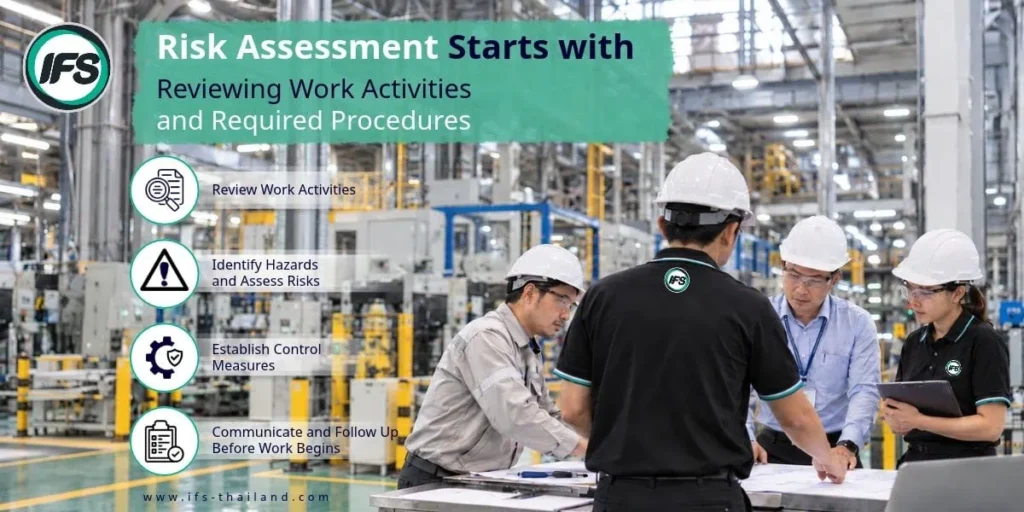
Risk Assessment Begins with Reviewing Work Activities and Procedures
Before identifying hazards and assessing risks, the HSE Department and operations team need to review the tasks and procedures involved. Even similar activities can present different risks depending on the location, work methods, equipment, and surrounding environment. Understanding these factors helps ensure that hazards are identified and appropriate controls are established for each worksite.
The review should cover the work area, access and exit routes, equipment, sequence of activities, and other people or operations nearby. Once the complete process is understood, the work can be divided into individual steps to systematically identify hazards and assess potential risks at each stage.
For example, describing a task simply as “glass roof cleaning” does not provide enough information for a thorough risk assessment. The actual process may include checking weather conditions, preparing equipment, accessing the site, reaching the work area, performing the cleaning, and removing equipment afterward. Each stage presents different factors that need to be evaluated.
| Work Stage | Key Considerations |
| Site and work area assessment | Check the glass roof’s location, height, access and exit routes, area below, glass condition, anchor points, and potential obstructions. |
| Cleaning methods and procedures | Determine whether ladders, scaffolding, aerial lifts, rope access systems, or other suitable methods should be used. Avoid stepping on or placing weight directly on glass panels unless they have been specifically designed and verified to support the load. |
| During the work | Assess weather conditions, including wind, rain, and heat, along with working height, surface conditions, slip and fall hazards, structural stability, and the risk of objects falling to areas below. |
| After completing the work | Check for equipment or materials left behind, wet surfaces, and any remaining cleaning requirements before reopening the area for normal use. |
Breaking tasks into individual stages also helps identify risks to others. For example, equipment used at height could fall into an occupied area, while cleaning activities may leave nearby surfaces wet and create hazards for building users.
The same principle applies to security services. Security personnel stationed at entrances, patrol officers, and traffic control officers may work within the same service category but face different conditions.
Patrol officers may encounter obstacles, hazardous areas, heat, poor lighting, or venomous animals. Traffic control officers must consider vehicle movement and their positioning relative to moving traffic. Interactions with visitors and other people entering the premises may also present risks if disagreements escalate into conflict.
Effective risk assessment therefore starts with understanding what employees do, where they work, and the conditions they face. This information provides the foundation for selecting appropriate risk control measures.
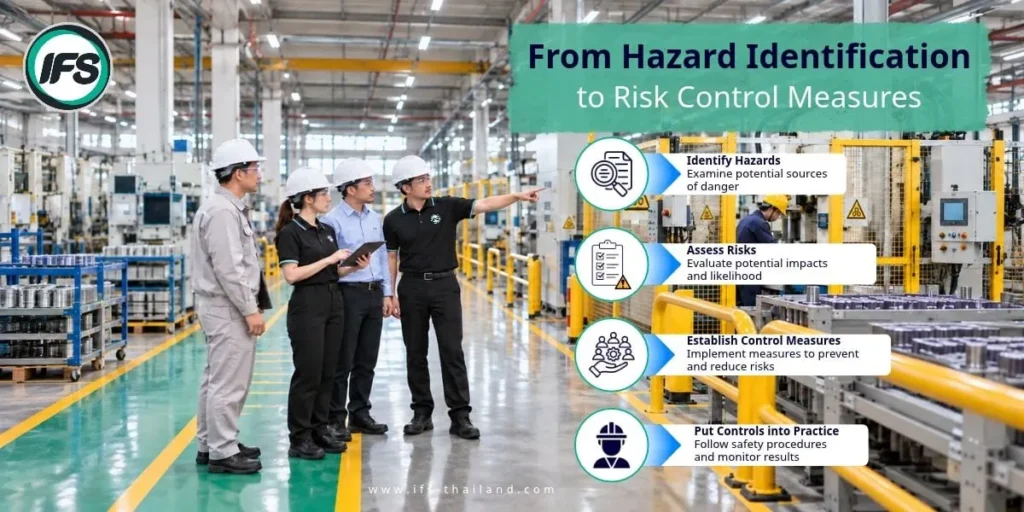
From Hazard Identification to Risk Control Measures
Once potential hazards have been identified at each stage of the work, the HSE Department must determine how the associated risks should be managed and which controls are appropriate for actual site conditions.
One approach is to assess where controls can be applied across three elements: Source, Pathway, and Person. This helps ensure that risk management goes beyond reminding employees to be careful or relying solely on personal protective equipment (PPE).
Source
The source is where a hazard originates. Examples include damaged machinery, exposed electrical wiring, slippery floors, or chemical leaks that could cause injuries.
Control measures: Inspect equipment to ensure it is safe and ready for use, and regularly eliminate or address potential sources of hazards.
Pathway or Work Area
The pathway refers to the route or area through which a hazard may reach a person. Examples include obstructed walkways, slippery surfaces, electrical cables across floors, or areas where dust and chemicals may become airborne.
Control measures: Keep walkways clear, display appropriate warning signs, and establish clearly defined barriers around hazardous areas.
For work at height, IFS safety requirements address several areas of risk control, including risk assessment, equipment inspection, worker readiness, and measures to prevent injuries from falling objects.
Person
The person refers to anyone who may be exposed to a hazard. Risk can increase when workers are unfamiliar with a task, lack sufficient safety awareness or knowledge, or do not use the required personal protective equipment.
Control measures: Provide safety training before work begins, ensure appropriate PPE is used, and require compliance with established safety rules and procedures.
In practice, managing a single risk may require several measures working together. For example, work at height may involve securing the area below, checking anchor points, using fall protection systems, and ensuring workers have appropriate PPE. Effective risk control should not depend on just one measure.
The same approach applies to chemical handling. Assessments should consider the type of chemical, how it will be used, and the potential for worker exposure. Additional information about chemical storage, container labeling, and Safety Data Sheets (SDS) is available in the dedicated article on chemical safety.
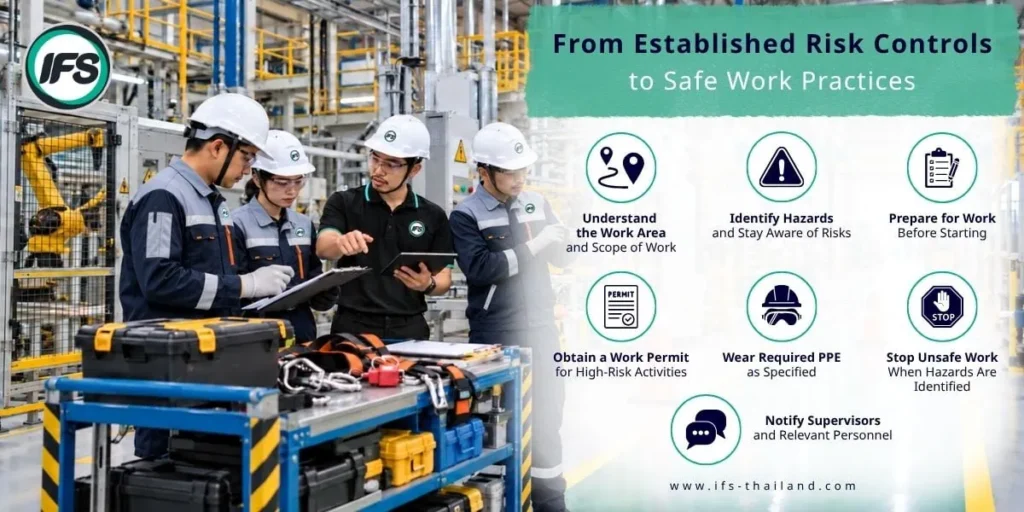
Turning Risk Control Measures into Safe Work Practices
Once risk controls are established, employees need to understand how to apply them to their work. Safety instructions may cover work area boundaries, potential hazards, preparations required before starting, necessary PPE, and conditions that require employees to stop work and notify the appropriate personnel.
For certain high-risk activities, a Permit to Work is one process used to put risk assessment findings into practice before work begins.
IFS requirements cover defining the scope of work, identifying hazards and assessing risks, establishing control measures, obtaining authorization from the person responsible for the work area, and communicating relevant information to anyone who may be affected.
The IFS Safety Rules also provide a framework for various workplace safety activities, including Working with Chemicals, Electrical Safety, Energy Isolation, Working at Heights, and Stopping Unsafe Work.
Employees must understand not only how to perform their duties safely, but also when work should not begin or continue.
Under IFS Stopping Unsafe Work requirements, employees must stop work and notify their supervisor or other responsible personnel if they do not fully understand the task, lack the necessary expertise, do not have the required PPE, or encounter unsafe conditions.
Work must not resume until the identified safety issues have been resolved.
For example, a cleaning employee may discover broken glass in an area where site rules prohibit wearing shoes. Attempting to remove the glass immediately could result in injury. The employee should first notify the person responsible for the area so that a safe and appropriate method can be arranged.
In another case, an employee encounters caustic soda on a floor scheduled for cleaning but continues working and experiences irritation. The appropriate procedure is to report the unusual condition or address the hazard before beginning the task.
These examples demonstrate why employees must recognize when actual site conditions differ from those covered by the original risk assessment.
The HSE Department is responsible for assessing risks and providing guidance, while supervisors and employees are responsible for implementing the established controls and reporting unsafe conditions.
Risk Assessments Must Be Reviewed When Conditions Change
A risk assessment reflects the work activities and site conditions at a particular point in time. When those conditions change, previously established controls may no longer be suitable.
The assessment should therefore be reviewed before work begins or continues under the changed conditions.
Situations that may require a review include:
- Changes to the work area or access routes
- Changes in tools or equipment
- Modifications to work procedures or methods
- Additional activities taking place in the same area
- An increase in the number of people using the area
- Newly identified hazards that were not included in the original assessment
- New incidents, observations, or information from the worksite
For example, an area below an elevated work location may initially be closed to building users. If that area is later reopened as a pedestrian route, the work above may remain unchanged, but the risks to people below and the required controls will be different.
Equipment changes require similar consideration. Even when the task itself remains the same, replacement equipment may differ in weight, handling requirements, or operating characteristics. Existing controls should be reviewed to determine whether they remain appropriate.
Input from frontline employees is especially valuable because they encounter actual working conditions firsthand.
IFS HSE policy emphasizes employee training, knowledge, safety awareness, and participation. Information from employees also supports regular reviews and continual improvement of workplace safety practices.
Reviewing a risk assessment does not necessarily mean the original assessment was incorrect. It is a way to confirm that the information and assumptions used previously still reflect current working conditions.
These principles of risk assessment, worker participation, and continual improvement are also reflected in occupational health and safety management systems such as ISO 45001, an international standard that specifies requirements for an occupational health and safety (OH&S) management system.
Risk Management Is Part of Service Quality
The HSE Department supports safe operations by assessing risks, providing guidance, and recommending controls suited to each task. Supervisors and employees are responsible for applying these measures and reporting changes or unsafe conditions that may affect the original assessment.
For corporate clients, these processes demonstrate the operational support behind frontline service delivery.
Work planning, risk management, and coordination among relevant teams help ensure that services are performed using methods appropriate to each facility, its operating environment, and the specific activities involved.
Frequently Asked Questions About Pre-Work Risk Management
Q: When should the HSE Department become involved?
A: The HSE Department should be involved during work preparation, once sufficient information is available about site conditions, work procedures, and proposed methods. Early involvement allows the team to assess potential risks and recommend appropriate controls before work begins.
Q: Can the same risk assessment be used for similar tasks at different locations?
A: Not automatically. Even when the task is the same, site conditions, equipment, work methods, and nearby activities may differ. Existing assessments and control measures should be reviewed to confirm they are suitable for the specific worksite.
Q: Should a risk assessment focus only on the employees performing the task?
A: No. Certain activities may also affect building users, nearby personnel, other stakeholders, or property. A comprehensive risk assessment should consider everyone and everything that could be affected by the work.
Q: What is the difference between a Risk Assessment and a Permit to Work?
A: A Risk Assessment identifies hazards, evaluates risks, and determines appropriate control measures. A Permit to Work is a formal pre-work control process used for certain high-risk activities. It incorporates risk assessment findings along with authorization and communication requirements before work begins.
Q: What should corporate clients look for in a facility services provider’s HSE system?
A: Corporate clients should consider how the provider assesses risks based on actual site conditions, develops appropriate control measures, communicates safety requirements to employees, and reviews assessments when working conditions change.