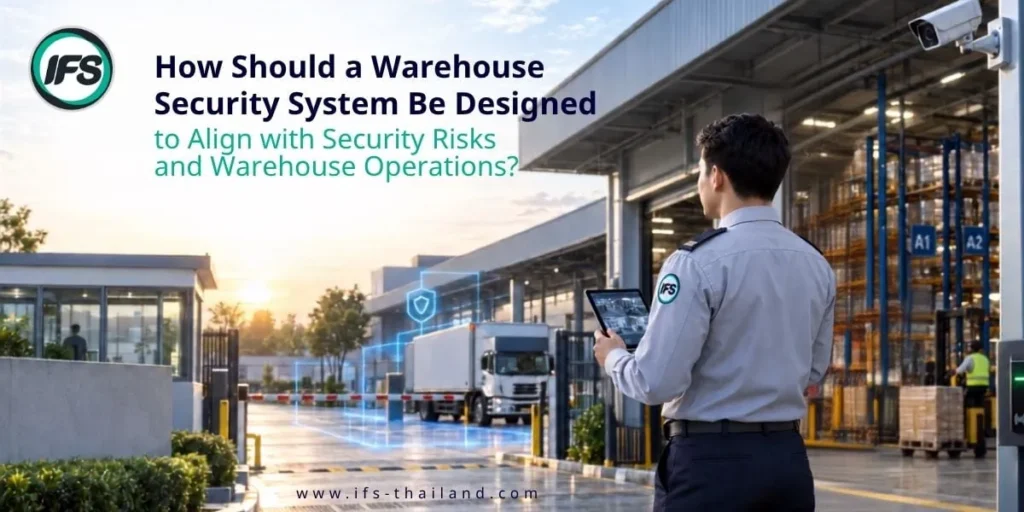
An effective warehouse security system should begin with a clear understanding of how people, vehicles, goods, and information move through the facility at different times. From there, control points, responsibilities, verification procedures, and supporting technologies can be designed to work together.
The objective is not only to prevent loss. A well-designed system should also help the organization detect and respond to irregularities without creating unnecessary steps that disrupt receiving, dispatch, or other day-to-day operations.
This article outlines IFS Group’s approach to warehouse security system design across key operational areas. It is intended to help warehouse managers, operations teams, facility teams, security teams, and procurement teams review existing controls, identify potential gaps, and determine where improvements may be needed.
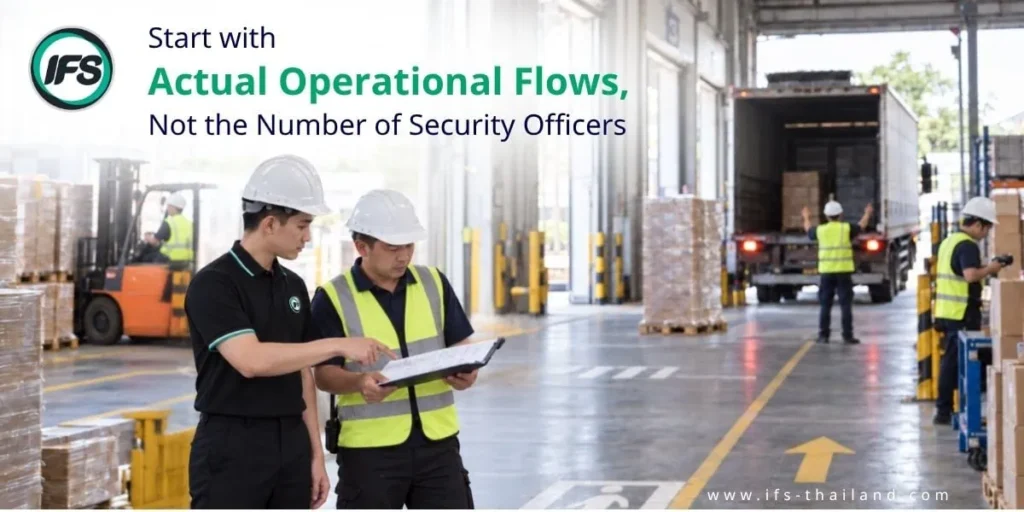
Start with Actual Operational Flows, Not the Number of Security Officers
A warehouse security system should not be designed around the number of security officers or cameras before the facility’s actual operations are understood.
Each warehouse has different types of goods, operating hours, vehicle volumes, controlled areas, and approval procedures. If the design starts with equipment or manpower alone, resources may be allocated to lower-risk areas while critical connections between people, vehicles, goods, and information remain insufficiently controlled.
IFS Group starts with a site survey and risk assessment before defining the service model. The key questions include who uses the facility, when vehicles enter and leave, where goods move, and who has the authority to make decisions when an irregularity occurs.
These findings are then used to define security posts, patrol routes, reporting procedures, and technologies that reflect actual operating conditions.
| Factors to Assess | Potential Risks | Implications for Security System Design |
| Type and value of goods | Loss, substitution, or unauthorized access to goods | Define security zones and assign access permissions based on roles |
| Operating hours and shift patterns | Unclear responsibilities during shift changes or nighttime operations | Establish handover procedures and security measures outside normal operating hours |
| Vehicle volume and peak periods | Incomplete verification, vehicle congestion, or skipped procedures | Define inspection sequences and provide suitable waiting areas for different traffic volumes |
| Movement routes for different groups | Visitors or contractors accessing unauthorized areas | Separate routes, establish registration points, and clearly define approvers |
| Receiving and dispatch procedures | Mismatched vehicle, document, goods, or seal information | Establish checkpoints, verification sequences, and authorized approvers before clearance |
| Incident history and previous deficiencies | Recurring issues because root causes have not been addressed | Use incident data to adjust checkpoints, procedures, and alert conditions |
This table provides an initial framework for reviewing warehouse security. It should not be treated as a standard template for every facility. Priorities should be based on the type of goods, site requirements, and the potential impact on operations.
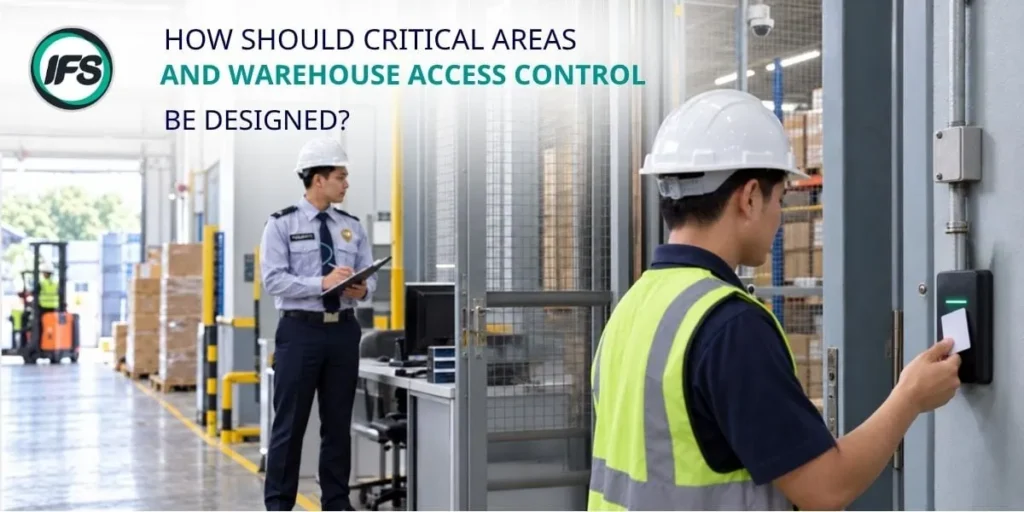
How Should Critical Areas and Warehouse Access Control Be Designed?
The design should reflect the function and risk level of each area.
At the main entrance, controls should focus on verifying identity, purpose, and access authorization. Receiving and dispatch areas should connect vehicle, driver, document, and goods information, while storage areas should restrict access according to roles and operating periods.
| Area | What Needs to Be Controlled | Design Approach |
| Main entrance | People, vehicles, purpose, and time | Verify authorization before entry and record required information |
| Registration point | Visitors, contractors, drivers, and contacts | Confirm the host or contact person, define permitted areas, and record departure |
| Receiving area | Vehicles, bays, documents, and goods | Verify information before receiving and separate exceptions from the normal process |
| Storage area | Goods, equipment, and restricted areas | Establish zones based on risk levels and record access |
| Staging and dispatch area | Picking lists, transport vehicles, approvers, and seals | Verify information before release and retain records for later review |
| Transport yard and parking area | Waiting points, routes, speed, and vehicle movement | Separate routes, reduce conflict points, and assign controllers where necessary |
| Perimeter and surrounding areas | Intrusion, blind spots, and after-hours irregularities | Integrate patrols, detection systems, and incident response procedures |
| Control room | CCTV footage, alarms, incident records, and coordination | Clearly define reviewers, report recipients, and escalation procedures |
For transport yards and loading areas, the security design needs to consider both asset protection and the safe movement of people and vehicles.
Checkpoints, waiting areas, and approved routes should be positioned so that trucks do not obstruct traffic and employees are not required to cross vehicle routes unnecessarily. Security officers should also perform their duties in line with internal traffic rules and site safety requirements.
For example, if a document checkpoint is positioned after an intersection leading into a loading yard, a vehicle with incomplete information may have to stop on the main route and block other traffic.
In this situation, adding more security officers may not solve the underlying problem. A better approach may be to reposition the checkpoint, provide a holding area, and separate vehicles requiring additional inspection from those that have already met the required conditions.
Connect People, Vehicle, and Goods Data Across the Entire Process
Control gaps do not always occur because a checkpoint is missing. They can also arise when different checkpoints use separate information that cannot be connected.
For example, the entrance may have vehicle registration information but no appointment record. The receiving point may have a delivery note but no confirmation that the vehicle has been approved for entry. The dispatch team may have complete documentation but no information confirming the identity of the recipient.
A more effective approach is to connect information throughout the entire process, from before the vehicle arrives until it leaves the facility:
- Pre-register or schedule the visit. Record the driver’s name, vehicle registration, company, purpose of visit, and the relevant contact or department.
- Verify at the entrance. Confirm the driver’s identity, vehicle, arrival time, and approval information before allowing access.
- Define routes and waiting areas. Direct vehicles to the relevant area without allowing them to leave approved routes.
- Receive or dispatch goods. Cross-check goods, documents, sender or recipient information, and seal status where applicable.
- Manage discrepancies. Move vehicles or goods with discrepancies to a designated holding area for further verification and escalation to an authorized decision-maker.
- Verify before exit. Confirm documents, assets, vehicle, driver, and authorization, and record the departure time.
Each checkpoint should clearly identify what information is being verified and how that information connects to the next stage.
For example, even when the driver’s name, vehicle registration, and receiving documents match, a seal number that does not correspond with the information provided should result in clearance being suspended. The incident should then be escalated to an authorized person and recorded according to the organization’s established procedures.

People, Processes, and Technology Must Work Together
Even a warehouse equipped with comprehensive security systems may still be unable to control risks effectively if no one is responsible for reviewing information, decision-making authority is unclear, or there is no response team when an alert occurs.
Security effectiveness therefore depends on how well people, processes, and technology are designed to work together.
People Assess Situations and Act According to Their Roles
Gate officers, patrol officers, CCTV operators, supervisors, and operations personnel have different responsibilities, but they need to work with connected information.
Security officers should understand which situations they are authorized to verify and approve, which should be placed on hold, and which incidents need to be escalated to an authorized representative of the organization.
Processes Define Procedures and Decision-Making Responsibilities
Standard operating procedures for each control point should clearly specify verification methods, required records, exceptions, authorized approvers, and incident reporting channels.
This is particularly important during shift changes, outside normal operating hours, system failures, or situations where vehicle and document information does not match.
Clear procedures reduce reliance on individual judgment or routine habits and help ensure that different shifts operate consistently.
Technology Supports Detection, Recording, and Information Flow
Technology should be selected according to the function of each control point.
Visitor management systems can manage appointment information. Access control systems can assign permissions by person, time, and area. License plate recognition systems can record vehicle information. CCTV can support monitoring and post-incident review, while guard tour systems can verify patrol times and locations.
When these systems work together, information from different control points can be connected to a Central Monitoring & Command Centre (CMCC), allowing responsible teams to review incidents, coordinate responses, and follow up using connected information.
For example, if a detection system identifies movement near the perimeter outside operating hours, the alert should first be sent to the responsible team for verification. The on-site team or other relevant personnel can then respond according to the assessed risk level, with the incident and response recorded accordingly.
Technology should therefore do more than generate alerts. It should support verification, response, and post-incident evidence.
IFS Group integrates security officers, electronic security systems, and its Central Monitoring & Command Centre (CMCC). Depending on the site context, solutions may include visitor management systems, access control systems, license plate recognition, under-vehicle inspection systems, CCTV, intrusion detection systems, and guard tour systems.
The appropriate combination should be determined after a site survey rather than applying the same technologies in the same way across every warehouse.
Learn more about IFS Group Security Services.
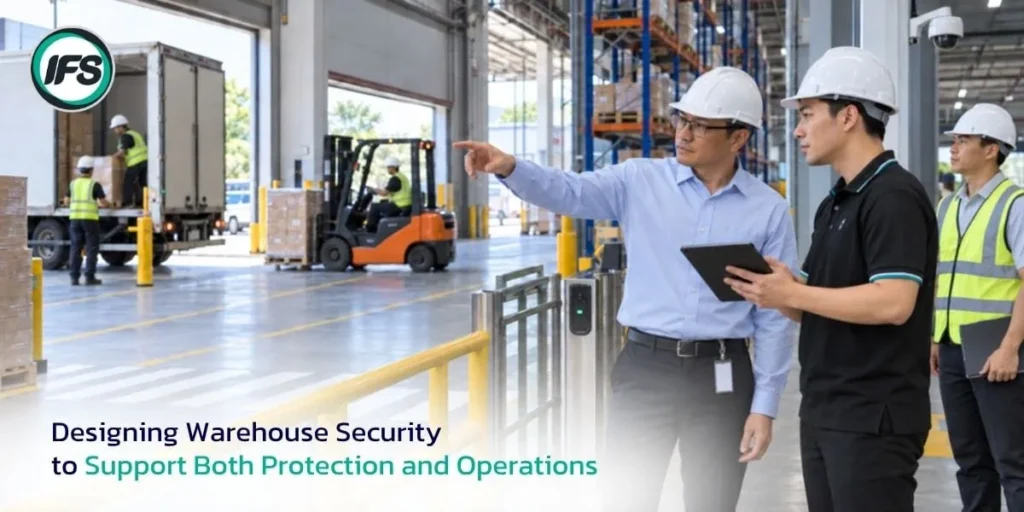
Designing Warehouse Security to Support Both Protection and Operations
Once an organization clearly understands the movement of people, vehicles, goods, and information, as well as the risks at each control point, it can design a security system that reflects actual warehouse operations.
This makes it possible to select the right combination of people, processes, and technology while managing irregularities without adding unnecessary workload or procedures to day-to-day operations.
With experience in providing security services for warehouses, IFS Group can conduct site surveys, assess risks, and work with organizations to design service models suited to their facilities, operational processes, and budgets.
The objective is to support effective security, appropriate resource utilization, and operational continuity.
Organizations looking to review their existing security systems can contact our team to discuss a service scope that fits their operational needs.
Frequently Asked Questions About Warehouse Security Systems
Q: What information should an organization prepare before a site survey?
A: Organizations should prepare site layouts, vehicle and goods movement routes, user group information, operating hours, entry and exit requirements, records of previous incidents or deficiencies, and details of existing equipment and systems.
This information helps the site survey focus more clearly on risk areas and potential gaps between operational processes.
Q: Can existing security equipment and systems continue to be used?
A: Each system should be assessed individually, considering equipment condition, area coverage, data quality, integration capability, and maintenance responsibilities.
If an existing system can still perform its intended function, the organization may only need to address specific gaps rather than replace all equipment.
Q: How can an organization determine whether it has too many or too few checkpoints?
A: Consider which risk each checkpoint controls, what information it verifies, and who receives that information.
If several checkpoints repeatedly verify the same information without contributing to a decision, those steps may need to be reviewed. Conversely, if people, vehicles, or goods pass through critical transition points without verification or supporting records, additional controls may be required.
Q: How should warehouse security performance indicators be defined?
A: Performance indicators should be linked to the risks and responsibilities of each control point.
Examples include patrol completion, the accuracy of entry and exit records, follow-up on irregularities, incident escalation times, and the completion of issues according to established procedures.
Definitions, data sources, reviewers, and reporting cycles should also be clearly established so that the metrics reflect actual security performance.
Q: Who should be involved in designing a warehouse security system?
A: Relevant stakeholders should include warehouse, operations, security, facility, and technology teams, as well as procurement when defining the scope of services.
Each function brings different information about risks and operational constraints. Collaborative design therefore helps ensure that security measures align with actual workflows and can be implemented effectively.