Ozone water cleaning technology is a chemical-free cleaning and disinfection solution that converts oxygen (O₂) into ozone (O₃) and dissolves it in water to create “aqueous ozone.” This solution can be used to wipe, spray, and clean high-touch and contact surfaces effectively. After use, ozone naturally decomposes back into oxygen, helping reduce the risk of chemical residues. Its performance can be validated through scientific indicators such as ORP and ATP.
The O3Clean Aqueous Ozone Generator is developed to support real-world applications in organizations and commercial buildings that require clearly defined and verifiable cleaning standards.
Compared with conventional chemical-based cleaning methods, which may deliver fast results but require chemical storage, pose risks to employees, generate fumes, and create environmental impact, many organizations are now seeking systems that provide comparable performance while offering greater safety and measurable outcomes.
“Effective cleanliness must be proven, not assumed.”
This approach elevates cleaning beyond visible results by supporting performance with quantifiable data and documented evidence. Organizations can establish standards, control quality, and report outcomes with clarity. This represents a significant distinction from traditional cleaning practices.
How Does an Ozone Water Generator Verify Disinfection Performance?
In enterprise-level cleaning management, evaluation should not rely solely on visual inspection. Verifiable data is essential to confirm results. An ozone water generator produces aqueous ozone for cleaning applications, and post-use performance can be assessed through scientific indicators to ensure standardized verification, documentation, and reporting.
The primary indicators include:
- ORP (Oxidation Reduction Potential).
- ATP (Adenosine Triphosphate) Surface Testing.
Both tools are widely used in the food industry, healthcare settings, and quality management systems because they provide quantifiable and auditable data.
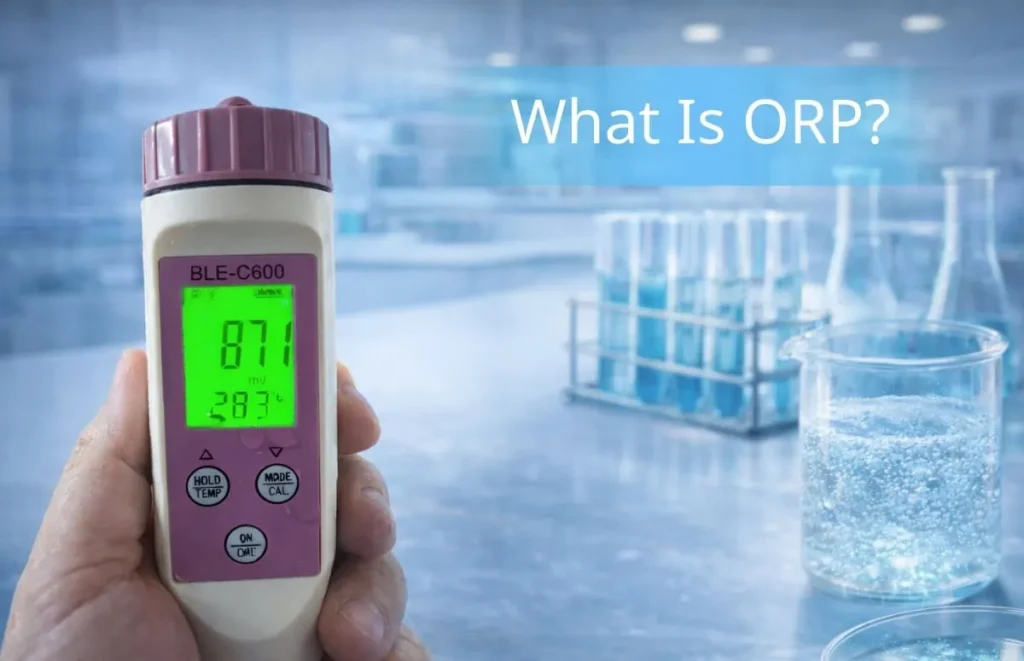
What Is ORP and Why Is ORP > 800 mV Used as a Disinfection Benchmark?
ORP (Oxidation Reduction Potential) measures a solution’s capacity to undergo oxidation-reduction reactions. It indicates the oxidative strength of a solution. In practical terms, the higher the ORP value, the greater its ability to inactivate pathogens, as it reflects the level of oxidative energy available to react with microorganisms and organic matter.
In hygiene applications, an ORP value above 800 mV is commonly used as a reference benchmark to confirm surface disinfection effectiveness. This level indicates sufficient oxidative power to disrupt bacterial cell walls and pathogen structures. It serves as a scientific measurement criterion rather than a subjective assessment based on perception or assumption.
Aqueous ozone possesses strong oxidative properties. When it comes into contact with microorganisms, it reacts rapidly. The oxidative strength of ozone dissolved in water directly correlates with the measurable ORP value, which is why ORP is used as a key performance indicator for disinfection effectiveness in this system.
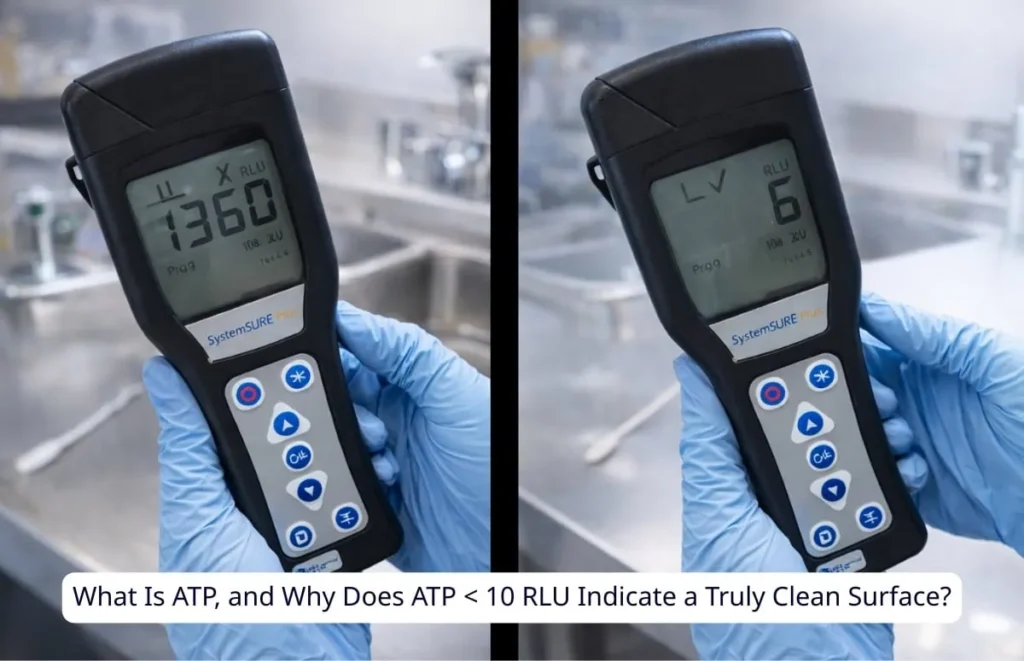
What Is ATP and Why Does ATP < 10 RLU Indicate a Truly Clean Surface?
ATP (Adenosine Triphosphate) is a molecule found in all living organisms, including bacteria, fungi, and organic residues. Measuring ATP levels on surfaces is therefore used as a method to assess contamination levels after cleaning.
ATP testing is a cleanliness verification process that produces numerical results expressed in RLU (Relative Light Units). The lower the value, the lower the amount of residual organic matter or microbial presence.
An ATP value below 10 RLU is commonly used as a reference level indicating that a surface meets hygiene cleanliness standards. This serves as a quantitative measurement criterion rather than a visual assessment.
Within the O3Clean Aqueous Ozone system, ATP test results are referenced to support real-world application. When combined with ORP measurements, cleaning performance can be clearly explained and validated using scientific data.
How Does Aqueous Ozone Work and Why Does It Not Require Chemicals?
The O3Clean Aqueous Ozone Generator produces ozone from oxygen in the air through an electrical process. It converts oxygen (O₂) into ozone (O₃) and dissolves it in water as aqueous ozone for cleaning applications. This process uses only:
- Water.
- Air.
- Electricity.
No additional chemicals are required. There is no need for dilution, formula mixing, or storage of multiple cleaning agents. The system relies on ozone’s oxidation mechanism to achieve cleaning performance. After use, ozone naturally decomposes back into oxygen.
How Does Oxidation Eliminate Microorganisms and Organic Contaminants?
Ozone (O₃) is a strong oxidizing agent. When ozone comes into contact with microorganisms, it reacts with cell walls and membranes, causing structural damage. Proteins and essential internal components are disrupted, resulting in the loss of microbial viability and a significant reduction in residual surface contamination.
At the same time, the oxidation reaction acts on organic contaminants such as grease, food residues, and odour-causing substances. Ozone breaks down their chemical structures into smaller molecules. This reaction occurs immediately upon contact, enabling both disinfection and stain breakdown within a single step.
Why Does Aqueous Ozone Leave No Residue After Use?
After completing the oxidation reaction, ozone decomposes back into oxygen. As a result, it does not leave chemical residues on surfaces and does not require rinsing with clean water.
Because of this characteristic, aqueous ozone is recognized as a cleaning approach that reduces reliance on conventional chemical agents.
What Types of Cleaning Applications Are Suitable?
The O3Clean Aqueous Ozone Generator is implemented across a wide range of organizations that require defined cleanliness standards, including office buildings, hotels, hospitals, educational institutions, commercial facilities, and commercial kitchens. Applications follow established procedures and operational guidelines rather than being limited to laboratory testing.
Typical applications cover common contact surfaces such as stainless steel, walls, tiles, floors, tables, counters, restrooms, glass surfaces, door handles, and elevator buttons. It can also be used in food-related areas, including food preparation equipment and the washing of fruits and vegetables, provided that defined procedures are followed.
Since aqueous ozone reverts to oxygen after use, it does not leave chemical residues on surfaces or food ingredients. It also helps reduce odours caused by organic matter and grease.
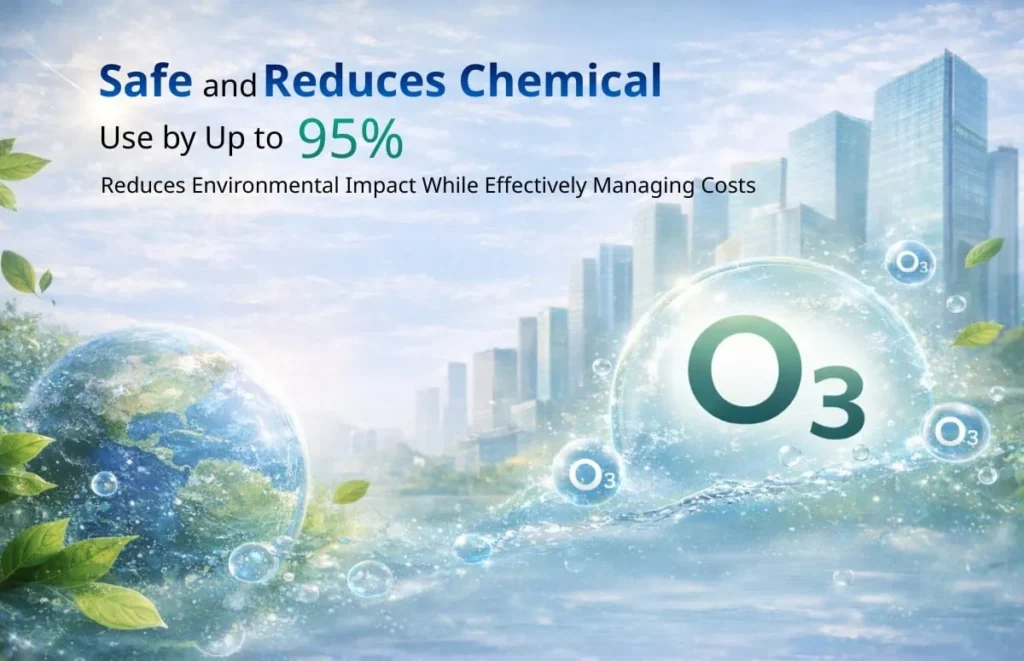
Safe and Reduces Chemical Use by Up to 95 Percent. How Does This Impact ESG and Costs?
Based on testing results and real-world implementation in organizations, chemical purchasing can be reduced by up to 95 percent and water consumption by more than 30 percent compared with conventional chemical-based cleaning systems. Actual results may vary depending on site conditions and usage patterns.
The system also reduces daily operational steps related to chemical mixing, storage, and inventory control. This streamlines workflows and shortens process time while reducing packaging waste generated after use.
How Does It Improve Safety for Staff and Building Occupants?
Using aqueous ozone reduces direct chemical exposure for staff, as there is no need to dilute solutions or store multiple chemical products within operational areas.
The system does not generate volatile organic compounds, or VOCs, which are airborne chemicals commonly associated with conventional cleaning agents. This reduces the risk of inhalation exposure and direct chemical contact during daily operations.
How Does It Support ESG Goals and Organizational Cost Management?
A 95 percent reduction in chemical use directly impacts both cost structure and environmental footprint. Organizations reduce procurement volume, transportation requirements, chemical storage, and plastic packaging waste from containers and chemical gallons.
This represents resource efficiency across the operational value chain, not only within the cleaning process itself. As a result, organizations can demonstrate measurable reductions in chemical consumption, waste generation, and overall resource use, aligning clearly with environmental objectives and ESG management frameworks.
Is Installation and Operation of O3Clean Complex?
The O3Clean Aqueous Ozone Generator is a wall-mounted system that connects to existing building water and electrical infrastructure. It can be integrated with the building’s current water system based on site requirements, enabling on-demand production and distribution of aqueous ozone for operational use.
Conclusion: A Verifiable Cleaning Standard with the Ozone Water Generator
The O3Clean Aqueous Ozone Generator is developed to provide enterprise-level cleaning with clearly defined standards, measurable performance, and traceable verification. It moves beyond visual assessment and confirms results through scientific data.
The system incorporates key decision criteria for organizations, including:
- Verifiable testing through ORP and ATP measurements as indicators of disinfection effectiveness and surface cleanliness based on established scientific principles.
- Proven real-world application across diverse building types and operational environments under defined procedures and quality control processes.
- Reduction of chemical use by up to 95 percent and water consumption by more than 30 percent based on organizational implementation, reducing procurement, storage, and inventory management burdens.
- Improved safety for staff and building occupants through reduced chemical exposure, absence of residues, and no VOC emissions from cleaning agents.
- Tangible support for ESG objectives and cost management through reduced transportation, storage requirements, and packaging waste.
When cleanliness standards can be measured and reported clearly, organizations can control quality, mitigate risk, and make decisions based on verifiable data.
Ozone water cleaning technology provides measurable indicators and documented evidence for cleaning performance. It is not merely a background support function, but a scientifically explainable and data-driven operational process.
For organizations that prioritize performance, safety, and environmental responsibility, ozone water cleaning technology represents a practical and structured solution aligned with enterprise-level operational requirements.
For organizations seeking to elevate cleaning standards to a measurable, data-driven system aligned with ESG frameworks, ozone water cleaning technology may be the solution you are looking for.