Many organizations are encountering recurring issues in daily operations. Unauthorized individuals enter restricted areas without being noticed. Situations escalate due to lack of control. Emergencies require immediate decisions, yet response is delayed.
When these issues occur repeatedly, an important question arises. Can security personnel effectively handle real-world situations?
What has changed is that organizations are no longer focused only on headcount. They are now evaluating whether security personnel possess the necessary skills, whether technology is in place to support them, and how effectively both people and systems work together in real operations.
This article provides an in-depth look at the essential skills security personnel must have in 2026, from fundamental capabilities to key considerations when selecting a professional security service provider that can truly enhance organizational safety.
Why Organizations Must Understand Security Guard Capabilities
Most organizations already have security personnel in place. The more important question is whether those personnel can effectively reduce operational risk.
Understanding security guard capabilities means understanding their responsibilities and what they are expected to handle in different situations. The key difference in real operations is not whether security personnel are present, but how they respond when an incident occurs.
Common real-world examples include:
- Individuals entering and exiting freely due to weak observation and screening.
- Minor issues escalating because no one intervenes early.
- Injured individuals waiting too long for assistance because no one can provide immediate first aid.
These situations do not occur because there are no personnel. They occur because essential skills are not fully in place.
Organizations should clearly understand these skill requirements in order to evaluate:
Whether the service provider offers only manpower or also provides structured training, clear operating procedures, and supporting technology such as monitoring centerscentres, access control systems, and alert mechanisms.
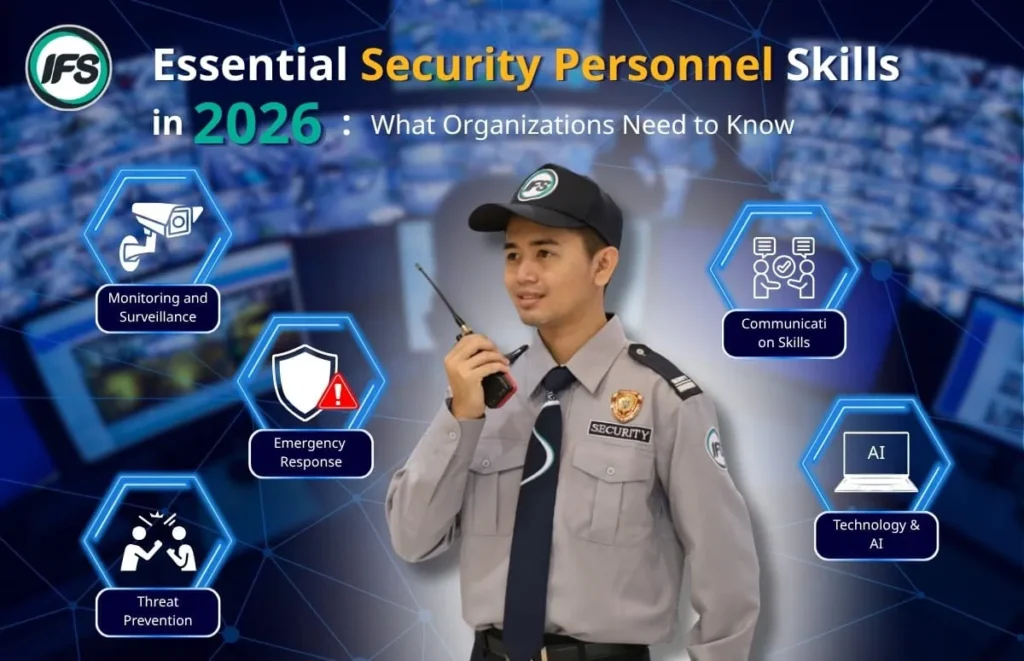
7 Essential Security Personnel Skills in 2026
1. Observation and Surveillance
The core responsibility of security personnel is the ability to notice what others may overlook.
- Conduct systematic area inspections.
- Identify unusual
behaviorbehaviour. - Perform initial risk assessments.
In real situations, early detection of small warning signs such as unusual movement patterns or behaviorbehaviour that does not match the environment can prevent larger incidents.
2. Communication and Reporting
Effective communication directly improves the ability to manage situations, especially when events unfold quickly under pressure.
Security personnel who communicate clearly can provide complete and accurate information, enabling faster and more effective decision-making.
Key capabilities include:
- Clear, professional, and concise communication.
- Structured incident reporting without missing critical details.
- Writing daily reports that allow immediate understanding when reviewed.
3. Situational Problem Solving
Real-world situations do not follow a script. Decisions often need to be made within seconds.
Well-trained and experienced personnel can assess situations quickly and respond without hesitation.
ในหน้างานจะเห็นชัดว่า รปภ. ที่มีประสบการณ์และได้รับการฝึกมาอย่างดี จะไม่ลังเลเมื่อเจอสถานการณ์กดดัน แต่จะประเมินสถานการณ์แล้วเลือกวิธีที่เหมาะสมทันที
Key capabilities include:
- Making timely decisions while prioritizing safety.
- Choosing appropriate responses based on the situation.
- Controlling incidents early to prevent escalation.
4. Emotional Control and Conflict Management
Organizations are placing increasing importance on emotional control and conflict management. Many issues in real operations begin with tension rather than technical problems.
Situations such as dissatisfied visitors, raised voices, or minor disagreements can escalate quickly if not handled appropriately.
Security personnel should be able to:
- Communicate in a way that helps de-escalate tension.
- Listen carefully before responding.
- Recognize when to handle a situation independently and when to escalate it to other teams.
In many cases, effective communication and emotional control are more important than physical force.
5. First Aid and Emergency Response
Security personnel are often the first to arrive at the scene of an incident, whether it involves unconscious individuals, minor accidents, or unexpected emergencies.
The first few minutes often determine the outcome. Immediate action can stabilize the situation, while delays can lead to greater impact.
Security personnel should be able to:
- Secure and manage the area before medical teams arrive.
- Provide basic first aid.
- Respond to fire incidents at an early stage to limit damage.
These are fundamental skills that play a critical role in reducing risk and impact.
6. Use of Technology and Equipment
Security operations today rely not only on personnel but also on integrated systems that support real-time decision-making.
These systems connect on-site operations with monitoring and command centerscentres, ensuring that information is shared and acted upon without delay.
Common tools include:
- CCTV systems that provide real-time alerts, not just recorded footage.
- Communication radios that enable immediate coordination across locations.
- Access control systems that verify identity and manage entry points.
Data from multiple sources is consolidated at a central monitoring centercentre, where teams can identify irregularities and respond immediately.
For example, if an intrusion attempt occurs, the system can trigger an alert, allowing the monitoring centercentre to notify nearby personnel to respond without delay.
This demonstrates the importance of integrating operational skills with technology.
7. Physical Fitness
Even with advanced systems and technology, physical readiness remains essential.
Security personnel are required to stand for extended periods, patrol areas, and respond quickly when incidents occur.
Without sufficient physical capability, performance may be limited, especially in situations that require immediate action.
Leading Security Service Providers in Thailand
Thailand has many security service providers. However, large organizations focus not only on manpower but also on the quality of personnel and the systems supporting them.
IFS Group is one of the providers trusted by leading organizations, with over 41 years of experience in security services.
What differentiates their approach is not simply deploying personnel but designing operations where people and systems work together effectively.
Key operational strengths include:
End-to-End Security Management
Security planning begins with risk assessment, site evaluation, and clear response planning for different scenarios.
Integration with Monitoring and Command Centre
In addition to on-site personnel, a central monitoring and command centre oversees operations and provides real-time support and coordination.
Technology-Driven Operations
Security technology is used to support accurate decision-making. This includes access control systems and real-time alert mechanisms that guide personnel on where to respond.
Continuous Skill Development
Ongoing training ensures personnel are prepared for emergency response, high-pressure communication, and effective use of security technology.
The approach begins with understanding operational risks, then designing both the team and the supporting systems accordingly.
As a result, personnel do not rely on assumptions. They act based on real-time data, enabling faster and more accurate responses.
Security Guard Capabilities Are the Foundation of Organizational Safety
Organizational safety is not defined by the number of personnel on-site. It is determined by how effectively the team can control situations from the beginning.
In real incidents, differences become clear within minutes.
The key factors are not headcount, but the skills of security personnel and the availability of supporting data that enables timely decision-making.
Organizations must clearly decide from the outset whether they are selecting a provider that is truly prepared to handle real situations, as performance will be tested the moment an incident occurs.
If your organization is seeking a security service provider with professional standards, advanced technology, and experienced personnel, contact IFS Group to discuss and design a solution tailored to your business needs. Click