Factory management today is no longer judged by production numbers alone. It now has to answer harder questions: Are costs staying under control? Do safety standards hold up to inspection? Are support systems truly running without interruption? And when something goes wrong, who is responsible?
These questions keep getting harder to answer because a single factory’s operations usually depend on several outside providers, each managing a separate piece. The more providers involved, the greater the risk of gaps in coverage.
This is why many organizations are turning to integrated facility management providers for their factories, bringing all support functions under one system, simplifying coordination, and improving overall operational efficiency.

Modern Industrial Factories Face Bigger Challenges Than Most Organizations Realize
Many factories invest continuously in machinery, automation, and added production capacity to grow and stay competitive. In reality, though, factory efficiency does not depend on the production line alone. The larger the site, the more buildings, or the more employees, the more complex the supporting functions become, from security and cleaning to engineering and workforce management.
Many organizations respond by hiring separate specialists for each function, so every task gets expert attention. The real challenge, however, is not any individual provider’s capability. It is getting all of them to work together smoothly.
When each provider follows different standards, workflows, and reporting formats, the burden of coordination falls on the facility management or operations team. Issues that need a joint decision then take longer to resolve than they should.
The cost of this fragmentation is not just financial. It builds up as lost time, delays, and risks that can affect the factory’s operations over the long term.
4 Key Components of Effective Factory Management

1.A Security System That Prevents More Than It Watches
Security in an industrial factory covers everything from controlling access to critical areas and protecting people and assets to reducing risks that could directly disrupt operations.
When security is connected to facility management and coordinated with other teams, incident response becomes faster and more systematic. The facility team can also track situations and manage risk more effectively.

2.Cleaning That Protects the Factory’s Standards
Many organizations think of cleanliness as a matter of appearance. In an industrial factory, though, it is directly tied to production quality, workplace safety, and the strict standards many industries require.
A systematic cleaning plan, the right service frequency, and ongoing quality checks reduce the risk of dust buildup, contamination, and other issues that could affect operations over time.
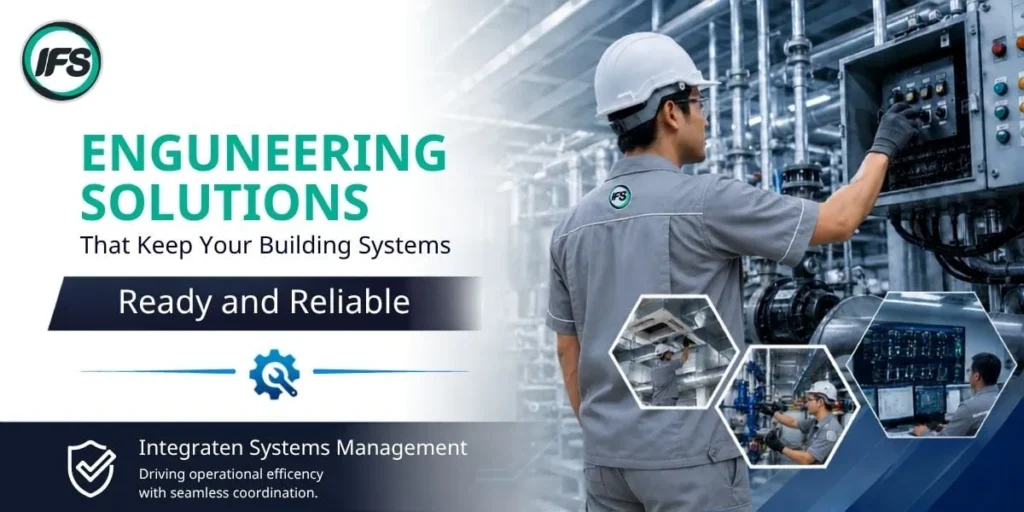
3.Engineering That Keeps Building Systems Ready to Run
Engineering systems form the backbone of continuous factory operations, covering everything from electrical and air conditioning systems to plumbing and other building infrastructure.
Preventive maintenance, scheduled inspections, and continuous equipment monitoring reduce the chance of breakdowns that could disrupt production, while extending the working life of factory assets.
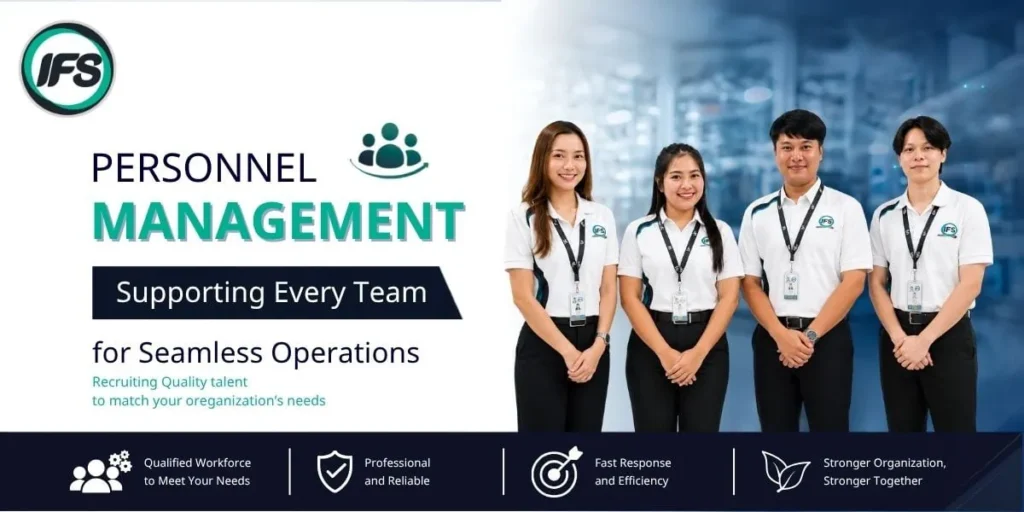
4.Workforce Management That Keeps Every Function Running
The people working inside a factory, whether support staff, administrative employees, or specialized teams, all play an important role in daily operations.
Workforce planning, recruitment, training, and ongoing performance monitoring help organizations maintain service quality, reduce staffing shortages, and adapt efficiently as the business changes.
These four areas are only examples of the core functions that keep a factory running. Factory management also includes common-area management, pest control, landscaping, restroom hygiene, energy management, and technology that improves operational efficiency. Whatever the service, the underlying principle stays the same: every function needs to work together systematically to support the factory as a whole.
What Organizations Should Consider When Choosing an Integrated Facility Management Provider
Every factory differs in how it operates, how large it is, and what its business goals are, so no single standard fits every organization. Looking at several dimensions gives a fuller picture of a provider’s capabilities and how well it can support the factory’s specific goals.
The following points are common criteria organizations use to evaluate integrated facility management providers.
The Ability to Manage Multiple Services as One System
The number of services on offer is only a starting point. Look deeper at how the provider connects those services together, from planning and execution to monitoring and emergency response. This is what determines whether the problems caused by fragmented service will actually go away.
Work Standards and Performance Tracking
Ask for measurable evidence: clear performance standards, reporting systems, and KPIs. These let an organization track service quality, analyze results, and use the data to plan ongoing improvements, instead of relying on gut feel or reports that arrive late.
Understanding How the Factory Actually Operates
A food factory’s safety requirements differ from a chemical plant’s, just as heavy-machinery production lines have different space and timing constraints than small-parts assembly. A provider that has already worked in real factory environments understands how to plan around these constraints far better than one without direct experience.
Flexibility to Adapt the Service Model
A factory might only need a cleaning team and a security team today, but expanding production or opening a new line changes its engineering and staffing needs too. A provider that can scale its services up or down as circumstances change will serve the factory better over time than one with a fixed scope.
Ultimately, these criteria are not meant to produce the same answer for every factory. They help you see which provider truly fits yours, both today and as your business grows.
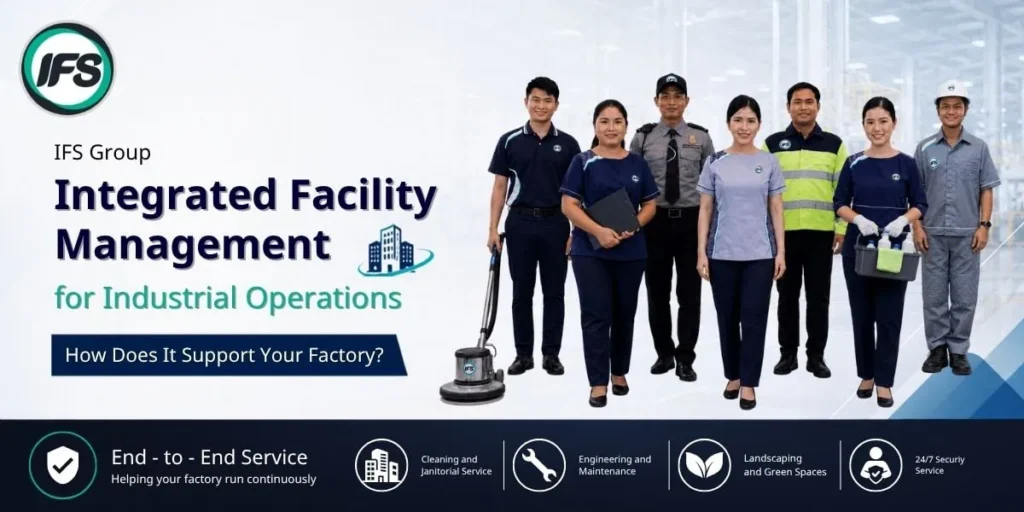
How IFS Group Brings Integrated Facility Management to Factory Operations
Over more than 40 years, IFS Group has grown into an Integrated Facility Management provider. Its coverage now spans building and site management across a wide range of industries, including industrial factories nationwide.
At the heart of this approach is a system designed from the outset to connect every service under one common standard: security, cleaning, engineering, workforce management, and other support functions. This replaces the fragmented, team-by-team approach many factories have experienced.
Every operation is backed by clear performance standards, tracking systems, and specialists in each field, letting organizations monitor service quality, analyze results, and continuously refine their management approach.
Today, IFS Group serves more than 2,000 sites nationwide with a team of over 30,000 people. That breadth of experience across industries allows IFS to design a management approach with each client that fits their specific context and needs.
When Every Service Works Together, the Factory Runs Efficiently
Choosing a provider for an industrial factory is about more than staffing a team. What follows is a management system that genuinely understands how the organization operates and helps set a consistent direction from the start.
With a clearer management structure, decisions rely on data rather than reactive fixes, and coordination becomes smoother. Organizations can then focus fully on growing the business, without worrying that small issues like a power outage or a late report will turn into major problems down the line.
In the end, choosing an integrated facility management provider is not just about the scope of services offered. It comes down to how effectively that provider can make every service work together to support the factory over the long term.
Frequently Asked Questions About Managing Modern Industrial Factories and Choosing an Integrated Facility Management Provider
Q: Is integrated facility management suitable for small factories too, or is it only for large ones?
A: It is not limited to large factories. The approach works for factories of any size, because what matters is not floor space or headcount, but the provider’s ability to design a scope that fits each factory’s context. Even a small factory with only two or three separate providers benefits from unifying standards and reporting into one system.
Q: How long does it take to transition from multiple providers to a single integrated provider?
A: The timeline depends on how many services need to be combined, the size of the site, and any existing contracts. The process typically starts with an assessment of the current setup, followed by a phased handover that avoids disrupting operations, and then the integration of standards and reporting. Organizations should discuss the transition plan with the provider early to keep it clear.
Q: Does integrated facility management cost more than hiring separate providers?
A: Direct service costs may be similar in the short term. The real difference is in hidden costs that go down: the time a facility team spends coordinating multiple providers, the risk of coverage gaps when providers do not communicate, and delays in resolving emergencies. These costs rarely show up on an invoice, but they affect overall efficiency.
Q: If we already have contracts with existing providers, do we need to cancel all of them to switch to integrated service?
A: No, not all at once. Many organizations phase in the switch as existing contracts expire. They typically start with the services that have caused the most coordination problems, then expand the scope as remaining contracts come up for renewal.
Q: Will an integrated provider replace the factory’s internal team?
A: No, it works alongside the internal team. The facility management or operations team still sets policy and makes strategic decisions. The integrated provider acts as a partner that handles day-to-day operations and reports results the internal team can use to make further decisions.
Q: How can we tell whether a provider under consideration is genuinely ready for integrated service?
A: Ask to see actual reporting systems and KPIs used with other clients. Ask how they handle emergencies that require coordinating multiple teams at once, and check their experience in industries similar to yours. A provider that is truly ready will describe these processes in concrete detail, not just in broad principles.