Facility management today requires organizations to manage multiple priorities at the same time. These include cleanliness, security, space readiness, and the overall experience of building users.
Smart Facility and Innovation supports facility service teams by combining people with digital technology. These systems provide useful information, help teams monitor conditions, and support more systematic service management based on the needs of each area.
For IFS Group, innovation in facility services is not about installing as much technology as possible. It is about selecting the right technology for the right task.
Cleaning robots can support routine cleaning across large areas. Electronic systems can strengthen security monitoring, while IoT sensors can provide real-time information about washroom conditions. Employees remain essential for tasks that require expertise, on-site assessment, attention to detail, and direct service.
What Is Smart Facility and Innovation in Facility Services?
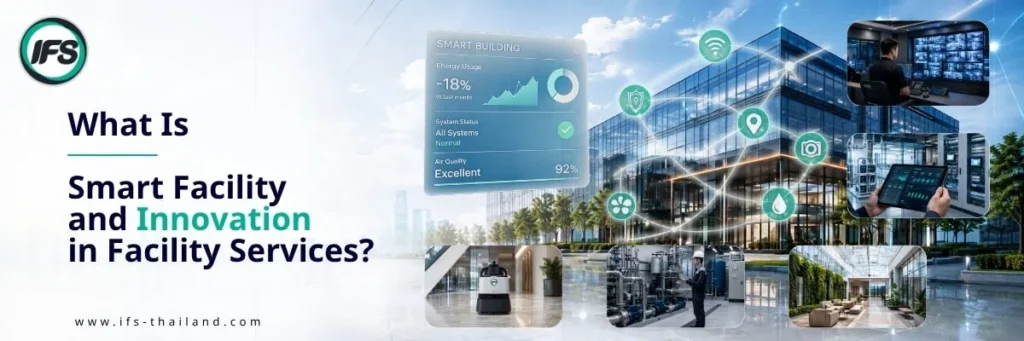
At IFS, Smart Facility and Innovation refers to the integration of technology and people in facility services to support cleaning, security, and washroom management according to the specific requirements of each area.
The approach consists of three main solutions:
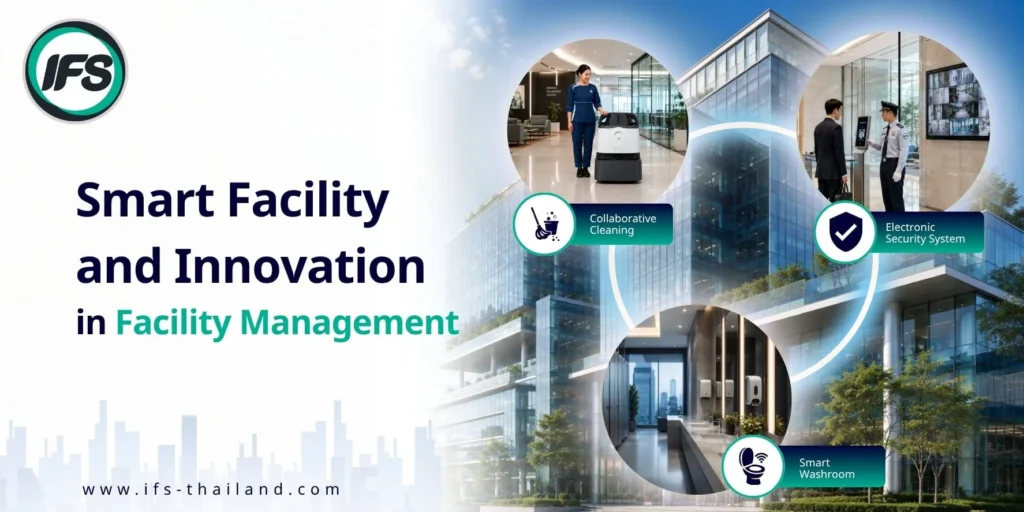
- Collaborative Cleaning – collaboration between cleaning personnel and intelligent cleaning robots
- Electronic Security System – electronic systems that support security monitoring and response
- Smart Washroom – smart washroom management using connected IoT sensors
Each solution serves a different purpose, but all follow the same principle: selecting technology that is appropriate for the task and using the information generated by the system to support employees in making informed decisions.
Effective facility management therefore depends not only on technology, but also on clearly defined responsibilities, operating procedures, and follow-up processes.
| Service Area | Technology or System | Role of Personnel | How Technology Supports the Service |
| Cleaning Services | Cleaning robots and AI | Handle detailed cleaning, narrow spaces, and hard-to-reach areas | Support cleaning across large areas and structured, repeatable tasks |
| Security Services | Access Control, License Plate Recognition, and Remote Detect | Monitor, assess, and respond to incidents | Support access management and surveillance of unusual activity |
| Washroom Hygiene Services | People Counter, Ammonia Sensor, and other sensors | Clean, maintain, and replenish consumables | Provide data on user traffic, ammonia levels, and consumable status |
Smart Facility and Innovation in Facility Management
Collaborative Cleaning: Assigning Tasks to People and Robots Based on Area Characteristics
Consider a building with a spacious lobby, long corridors, elevators, parking areas, furniture, narrow spaces, and hard-to-reach areas. Each type of space requires a different cleaning approach, so the same method should not be applied everywhere.
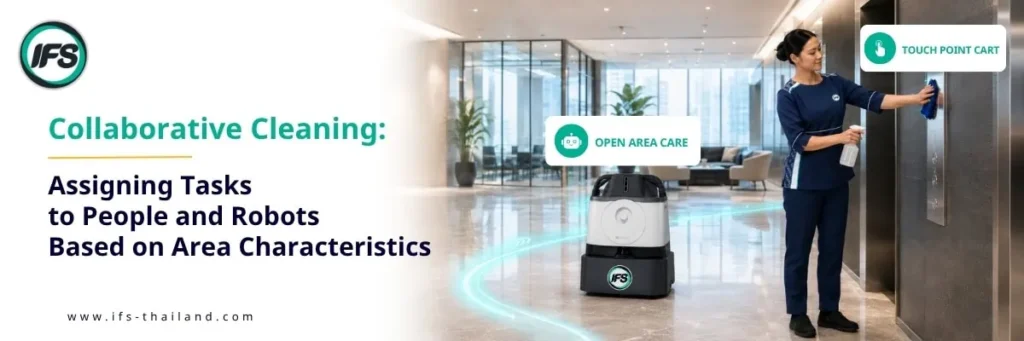
Collaborative Cleaning divides responsibilities between cleaning personnel and intelligent cleaning robots. AI-powered robots learn designated areas and handle structured, repeatable tasks in large spaces or areas that require continuous cleaning, such as lobbies, building corridors, and parking areas.
Employees, meanwhile, focus on tasks that require greater attention to detail or specialized skills, such as cleaning furniture, narrow spaces, and hard-to-reach areas.
This division of responsibilities allows the team to apply the most appropriate cleaning method to each type of area. Robots take on repetitive tasks with clearly defined boundaries, giving employees more time to assess site conditions, select appropriate cleaning methods, and inspect completed work rather than spending that time on repetitive cleaning across large areas.
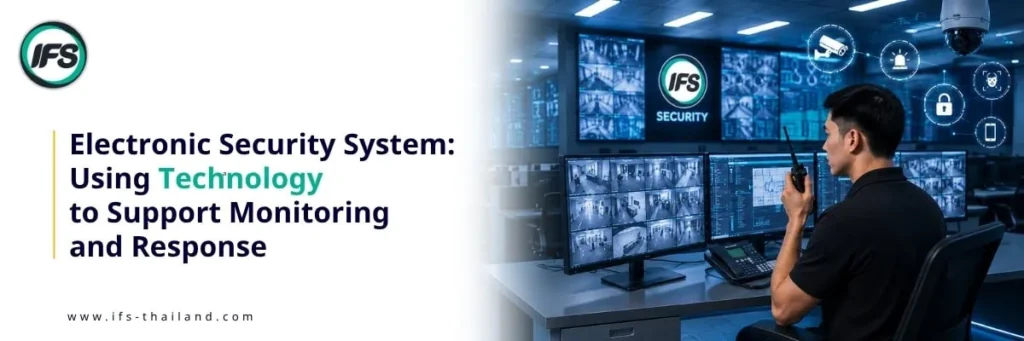
Electronic Security System: Using Technology to Support Monitoring and Response
Facility security covers people, visitors, vehicles, and controlled areas. Technology supports the work of security personnel by assisting with access management, surveillance, and response to unusual activity.
IFS offers a range of systems, including Access Control, License Plate Recognition, automatic barrier gate systems, visitor badge issuance systems, Visitor Management System (VMS), and Remote Detect, a remote motion detection solution.
Each system serves a different function depending on the characteristics of the facility and its security requirements.
For visitor management, VMS allows visitors to pre-register through a link or QR code. The host can review and approve the request and specify authorized entry and exit times.
When the visitor arrives, the system notifies the host and stores visitor information in the cloud for easy retrieval and reference. This reduces manual recordkeeping and helps organize visitor information more systematically.
For surveillance, Remote Detect monitors and analyzes intrusion events in real time. The system can distinguish between people, animals, and vehicles, helping reduce false or unnecessary alerts.
Remote Detect is also connected to the IFS Central Monitoring & Command Centre (CMCC), which monitors, analyzes, and coordinates responses 24 hours a day.
The effectiveness of an electronic security system therefore depends on more than the number of devices installed. It also relies on how effectively system data is integrated with the work of security personnel.
When an incident is detected, the monitoring centre and on-site security teams can use the available information to assess the situation and follow established response procedures. This enables technology and people to work together in a more coordinated and systematic way.
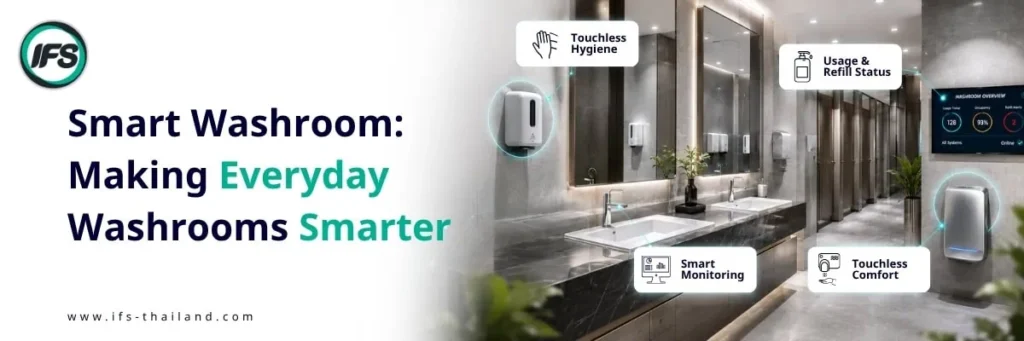
Smart Washroom: Making Everyday Washrooms Smarter
Smart Washroom uses IoT sensors to monitor data and conditions inside washrooms, giving service teams clearer information to support day-to-day washroom management.
A People Counter Sensor tracks the number of users, while an Ammonia Sensor measures ammonia levels inside the washroom.
If ammonia levels exceed a predefined threshold, the system alerts employees so they can take appropriate cleaning action. This helps service teams respond more effectively to actual conditions within the washroom.
Additional sensors can monitor soap levels, waste levels, and remaining toilet paper, helping service teams identify where replenishment or attention is required.
A Rating & Customer Feedback Panel also allows users to rate their experience through a tablet located inside the washroom, providing another channel for collecting user feedback.
Smart Washroom also encompasses Signature Washroom, which enhances the washroom experience through hygiene and service elements such as fragrance, foam hand soap, and other washroom amenities.
Integrating sensor data with washroom hygiene services helps improve washroom management efficiency while creating a better experience for building users.
The Value of Smart Facility and Innovation for Facility Management
Smart Facility and Innovation demonstrates that effective facility management does not require choosing between technology and people. Instead, both should be designed to complement each other according to their respective strengths.
This approach supports cleanliness, security, space readiness, and the overall experience of building users.
Technology should not be evaluated simply by the number of devices or systems installed. Organizations should select solutions based on real operational needs, enabling employees to manage facilities in line with organizational goals while continuously improving service quality to meet the evolving needs of building users.
IFS Group works with organizations to design technology-enabled service approaches that improve facility management efficiency while reflecting the characteristics and usage patterns of each facility.
Frequently Asked Questions About Smart Facility and Innovation
Q: What types of buildings or facilities are suitable for Smart Facility and Innovation?
A: Smart Facility and Innovation is suitable for buildings and facilities that require ongoing management of cleanliness, security, and space readiness. Technologies can be selected according to the characteristics of the facility and the needs of each organization, including office buildings and retail spaces.
Q: Will cleaning robots reduce staffing requirements or replace cleaning personnel?
A: Collaborative Cleaning is designed around cooperation between cleaning robots and employees. Robots support cleaning across large areas and handle structured, repeatable tasks, while employees focus on work that requires skills, attention to detail, or access to hard-to-reach areas.
The purpose is to assign responsibilities according to the nature of the work, rather than to replace cleaning personnel entirely.
Q: Does an Electronic Security System need to work alongside security personnel, or can it replace them?
A: An Electronic Security System supports monitoring and surveillance, while security personnel and the monitoring centre continue to assess situations and coordinate responses when incidents occur.
The system is therefore designed to combine technology with human expertise rather than replace security personnel.
Q: How does Smart Washroom improve washroom management efficiency?
A: Smart Washroom uses IoT sensors to monitor information such as user traffic, ammonia levels, and consumable levels. This gives service teams the information they need to manage washroom conditions and respond more appropriately to actual usage.
Q: How should an organization get started with Smart Facility and Innovation?
A: The process should begin by assessing the organization’s needs, facility characteristics, and operating requirements. Appropriate technologies or solutions can then be selected for each task.
IFS can work with organizations to design an approach that aligns with the specific needs of each business.